
Blog
How the 5% and 10% QOF Basis Step-Ups Affect Your 2026 Gain Calculation
The 5% and 10% basis step-ups can shrink the deferred gain a legacy QOF investor must recognize on December 31, 2026, but only if the investment was made early enough to hit the five- or seven-year holding mark. This guide walks through who still qualifies and shows the exact arithmetic with two worked examples.
If you invested deferred capital gain into a qualified opportunity fund before the window closed, your December 31, 2026 recognition amount is not simply the gain you originally rolled over. Two statutory basis increases, 10% and an additional 5%, can reduce that number before the lesser-of rule even applies. This piece focuses specifically on how those step-ups are calculated and who still qualifies for them.
We've already covered how the lesser-of rule determines your 2026 inclusion amount by comparing reduced deferred gain against fair market value minus basis. This article picks up where that one leaves off: the mechanics of the basis step-up itself, which is the piece that lowers one side of that comparison.
What the Basis Step-Up Actually Does
The step-up increases your tax basis in the QOF investment, which in turn reduces the amount of originally deferred gain you recognize on the statutory inclusion date. Under 26 U.S.C. Section 1400Z-2(b), deferred gain is recognized on the earlier of a sale of the QOF interest or December 31, 2026. For investments held through that date, the code allows two separate basis increases tied to holding period:
- A 10% basis increase if the QOF investment was held at least 5 years as of the recognition date.
- An additional 5% basis increase (15% total) if the investment was held at least 7 years as of the recognition date.
Because the recognition date is fixed at December 31, 2026, these holding-period thresholds translate directly into investment-date deadlines. To reach 5 years, the investment had to be made by December 31, 2021. To reach 7 years, it had to be made by December 31, 2019. Both windows have been closed for years, so the step-up is only relevant to investors whose capital has already been sitting in a fund since one of those dates, as described in IRS guidance on qualified opportunity fund investments and confirmed by recent industry analysis of the December 31, 2026 recognition calculation.
Who Still Qualifies for a Step-Up in 2026?
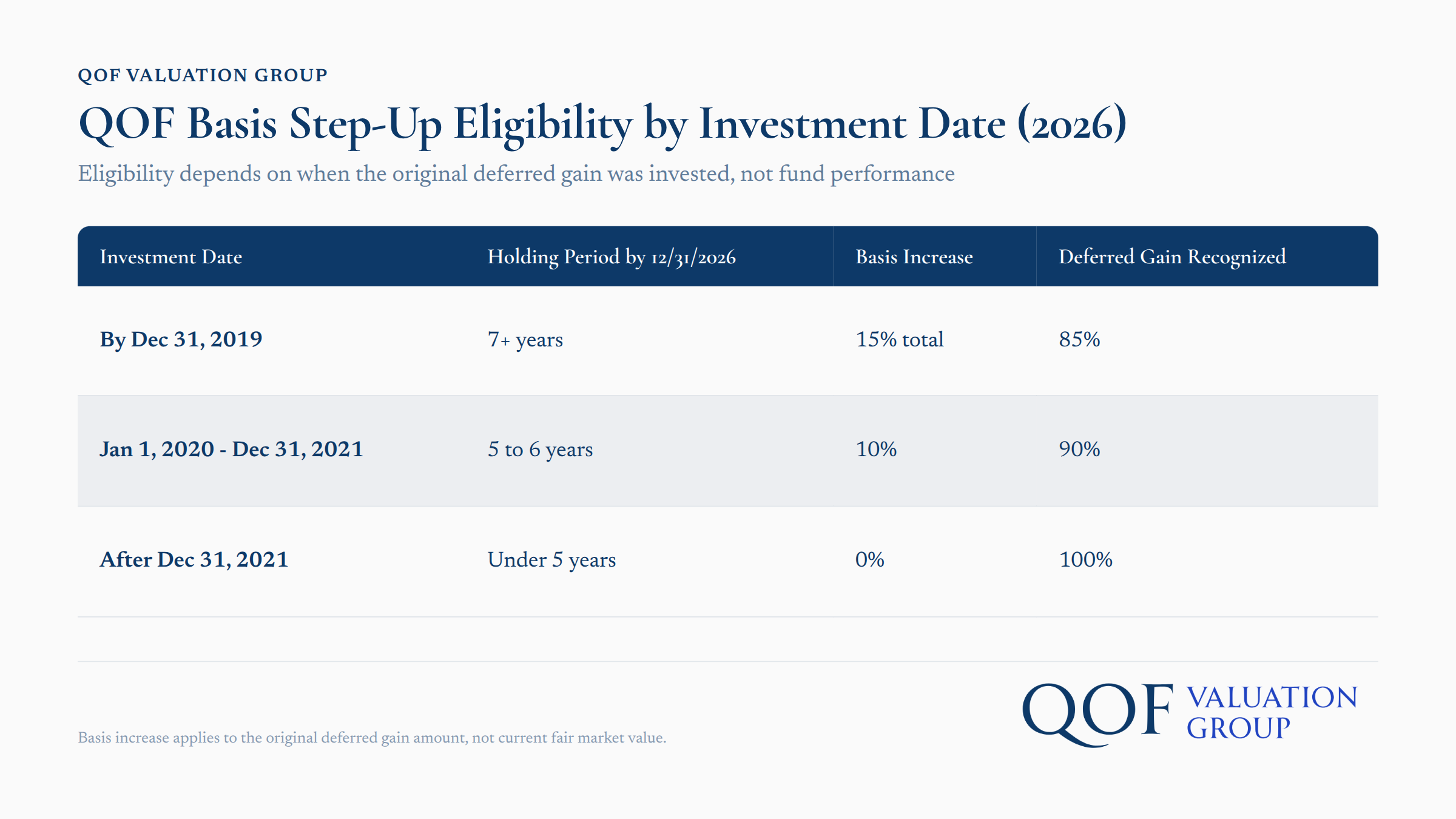
An investor's eligibility depends entirely on when the original deferred gain was invested, not on how the fund has performed since. The table below summarizes the three possible outcomes.
| Investment date | Holding period by 12/31/2026 | Basis increase | Share of original deferred gain recognized |
|---|---|---|---|
| By December 31, 2019 | 7+ years | 15% total | 85% |
| January 1, 2020 through December 31, 2021 | 5 to 6 years | 10% | 90% |
| After December 31, 2021 | Under 5 years | 0% | 100% |
The basis increase is calculated as a percentage of the amount of gain originally deferred, not as a percentage of the fund's current fair market value. An investor whose deferred gain has since doubled in value still only steps up basis relative to the original deferral amount. This is a narrower benefit than many investors expect, and it is worth confirming with your own investment records rather than assuming based on how long you believe you've been in the fund.
The Step-Up Is One Input Into the Lesser-of Calculation
The basis step-up only reduces one side of the comparison that ultimately sets your 2026 inclusion amount. As we covered previously, the taxable amount is the lesser of the reduced deferred gain (after any step-up) or the fund interest's fair market value minus basis. A large step-up does you no good if the fund's value has fallen so far that the FMV-minus-basis figure is already the smaller number. The two worked examples below show both outcomes.
Worked Example: An Early Investor Whose Step-Up Governs
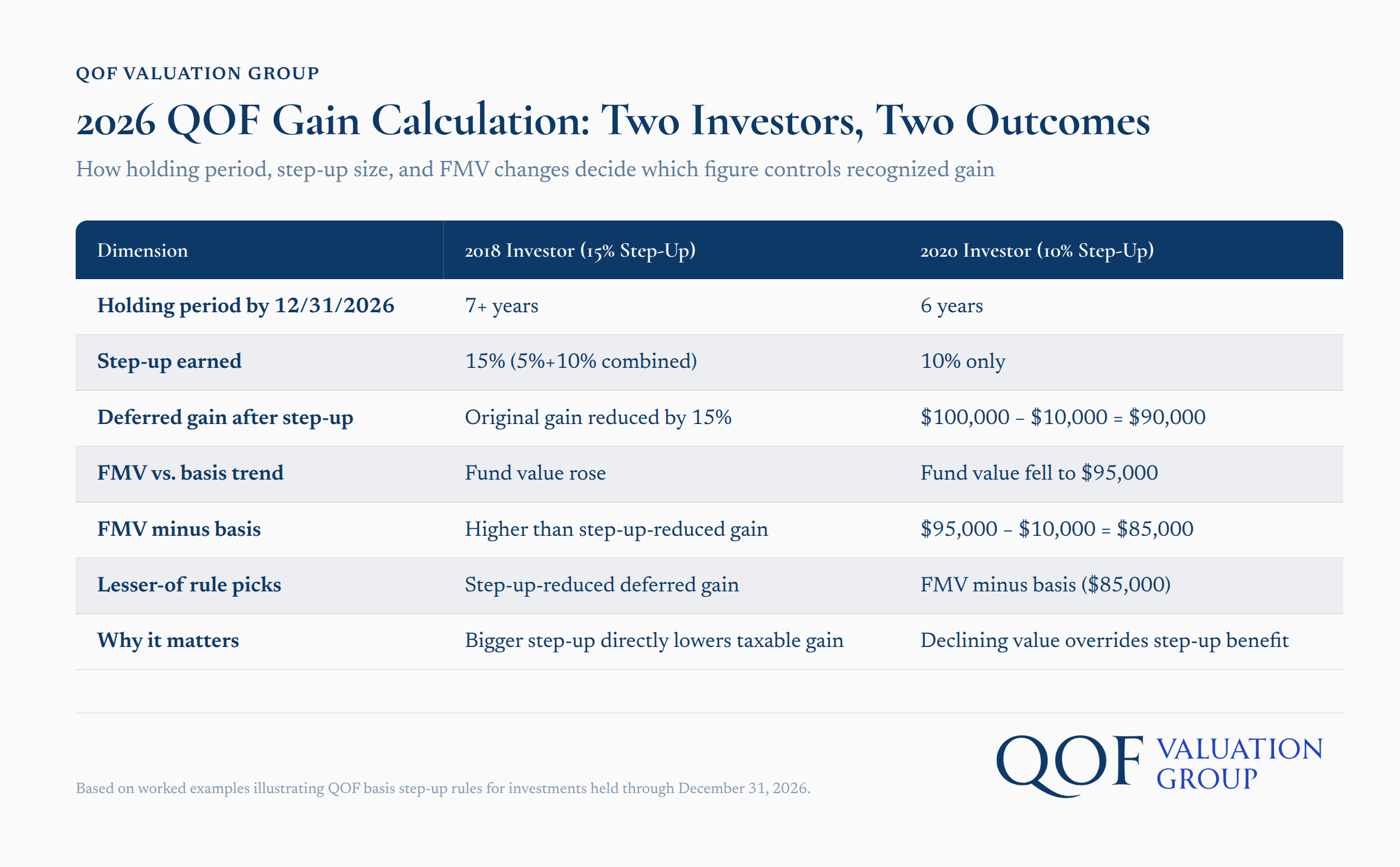
An investor rolled $100,000 of eligible gain into a QOF in 2018 and still holds the interest on December 31, 2026. That is an 8-year holding period, past the 7-year threshold, so the full 15% step-up applies.
- Basis increase: $100,000 x 15% = $15,000.
- Reduced deferred gain: $100,000 - $15,000 = $85,000.
- The fund has appreciated well. Its current fair market value is $300,000, against a basis of $15,000, so FMV minus basis = $300,000 - $15,000 = $285,000.
Comparing the two figures, $85,000 (reduced deferred gain) is far smaller than $285,000 (FMV minus basis). The lesser-of rule picks the smaller number, so this investor recognizes $85,000 of gain in 2026, a $15,000 reduction from the original $100,000 deferral, purely because the step-up was the binding figure.
Worked Example: A Later Investor Where FMV Governs Instead
A second investor deferred $100,000 of gain into a different QOF in 2020. By December 31, 2026 that is a 6-year holding period, enough for the 10% step-up but short of the 7 years needed for the additional 5%.
- Basis increase: $100,000 x 10% = $10,000.
- Reduced deferred gain: $100,000 - $10,000 = $90,000.
- Unlike the first fund, this one has declined in value. Current fair market value is $95,000, against a basis of $10,000, so FMV minus basis = $95,000 - $10,000 = $85,000.
Here the comparison flips. FMV minus basis ($85,000) is actually lower than the step-up-reduced deferred gain ($90,000), so the lesser-of rule picks $85,000 as the recognized amount. The step-up still helped, it just was not the decisive factor. A decline in a QOF's value changes which number in the comparison actually controls, and that is exactly what happened in this case.
Key takeaway: The step-up lowers the deferred-gain side of the calculation, but a declining asset can make the fair-market-value side control the outcome regardless of how generous the step-up is.
Don't Confuse This With the 10-Year Exclusion
The 5% and 10% basis step-ups are a distinct benefit from the permanent exclusion available to investors who hold a QOF interest for at least 10 years. That separate rule lets a long-term holder step basis all the way up to fair market value at the time of sale, eliminating tax on the appreciation earned inside the fund. It addresses what happens when you eventually sell. The 5% and 10% step-ups addressed in this article only reduce the deferred gain recognized on December 31, 2026, the mandatory inclusion date, and have nothing to do with gains earned after the original investment was made.
IRS transition guidance also describes a different step-up structure, including a potential 30% increase for certain rural opportunity fund investments, that applies only to capital invested after December 31, 2026, under the renewed opportunity zone framework. That framework does not apply retroactively to the legacy investments discussed here. Keeping these three rules distinct (the legacy 10%/15% step-up, the 10-year FMV exclusion, and the post-2026 rules) matters because conflating them leads to an incorrect 2026 number.
Why Valuation Matters for the FMV Side of the Calculation
The step-up calculation itself is arithmetic: multiply the original deferred gain by the applicable percentage. The harder part of the comparison is usually the other side, establishing a defensible fair market value for the QOF interest as of the recognition date, particularly when the fund holds real estate or an operating business rather than liquid securities. An appraised FMV supports the position that the fund interest is worth less than the reduced deferred gain, which is the only scenario in which FMV becomes the binding, lower number.
Our qualified opportunity fund valuation services are built around exactly this calculation: establishing a supportable fair market value for a QOF or QOZ business interest as of a specific date, so the lesser-of comparison holds up to IRS scrutiny. Appraisers working on these engagements generally hold credentials with organizations such as the American Society of Appraisers and the National Association of Certified Valuators and Analysts, and reports are prepared in accordance with the Uniform Standards of Professional Appraisal Practice.
Confirm Your Investment Date Before You Assume a Step-Up Applies
The single most common mistake investors make heading into the 2026 inclusion date is assuming a step-up applies because the investment "feels old." The actual test is a specific calendar cutoff: December 31, 2021 for the 10% increase, December 31, 2019 for the full 15%. Pull your original Form 8949 or Form 8997 filings to confirm the exact date the gain was invested, then run both sides of the lesser-of comparison before filing. If the fund's value has moved meaningfully in either direction since the original investment, a current, supportable valuation is the piece that will determine which number actually governs your 2026 tax bill.
This article is provided for general informational purposes only and does not constitute legal, tax, or financial advice. Readers should consult a qualified attorney or CPA regarding their specific circumstances.