
Blog
How to Value a QOF Interest That Has Dropped Below Your Deferred Gain
If your qualified opportunity fund interest is now worth less than the gain you deferred, the December 31, 2026 mandatory inclusion may let you recognize far less than that original amount. This guide walks through the lesser-of rule, the appraisal factors that can push the value down, and a worked example showing the math.
Every investor who deferred a capital gain into a qualified opportunity fund (QOF) faces the same date on the calendar: December 31, 2026. On that date, the remaining deferred gain becomes includible in income whether or not the investor has sold the interest. What many investors do not realize is that the amount they owe tax on is not automatically the full original gain. It is the lesser of that original gain or the fair market value of the QOF interest itself, and if the fund's value has fallen, an appraisal can be the difference between a large tax bill and a modest one.
Our qualified opportunity fund valuation team prepares the fair market value documentation investors need to support this position. This article walks through the mechanics, the three factors that most often push a QOF interest below the original deferred gain, and a worked example showing how the numbers come together.
The Lesser-of Rule: What IRC 1400Z-2(b)(2)(A) Actually Says
Under IRC 1400Z-2(b)(2)(A), the amount an investor must include in income on the mandatory inclusion date is the lesser of the remaining deferred gain or the fair market value of the qualifying investment, reduced by the investor's basis. The IRS FAQ on Opportunity Zones confirms that the inclusion amount turns on the FMV of the QOF interest on the inclusion date, not simply on the original amount deferred back when the investment was made.
That single word, "lesser," is the entire opportunity here. If the fund's underlying assets have lost value, or if the interest itself carries discounts a buyer would demand, the appraised FMV can land well below the original gain. Practitioners who have written about the 2026 deadline describe this as a genuine planning lever, not a loophole, because the statute was written this way deliberately: investors bear the market risk of the fund, and the tax code recognizes that risk when it comes time to pay up. A recent analysis in The Tax Adviser walks through the calculation in more depth, and our own guide to the lesser-of rule covers the filing mechanics for investors who want the full picture before engaging an appraiser.
Gain Only Counts Above Your Basis, and Your Basis Just Went Up
The second half of the calculation is basis. Under IRC 1400Z-2(b)(2)(B)(i), gain is recognized only to the extent the FMV of the QOF interest exceeds the investor's basis in it, and most original QOF investments started with a basis of $0.
That basis moves over time, though. Investors who held their QOF interest for at least 5 years by the inclusion date receive a 10% step-up in basis, and those who held for at least 7 years receive a 15% step-up, both calculated against the original deferred gain, as confirmed in industry summaries of the 2026 deferral rules. Because the 7-year holding period generally requires an investment made by the end of 2019, most investors who deferred a gain in the program's early years qualify for the larger step-up heading into the 2026 inclusion date.
Key takeaway: A higher basis shrinks the taxable gain even if the FMV stays flat, and it works in combination with the lesser-of test rather than instead of it.
What Fair Market Value Means for a QOF Interest
There is no opportunity-zone-specific definition of fair market value. Appraisers apply the same standard used across the appraisal profession: the price a hypothetical willing buyer would pay a hypothetical willing seller, with neither under compulsion to act and both reasonably informed of the relevant facts.
Applied to a QOF interest, this means the appraiser is not simply pricing the fund's underlying real estate or business at its stabilized, finished value. The appraiser is pricing the specific interest the investor holds, as of December 31, 2026, accounting for everything a real buyer would weigh before writing a check: the fund's leverage, its stage of development, how much control the investor actually has, and how quickly (or slowly) that interest could be converted to cash. This is where a properly credentialed appraisal, prepared by a valuator holding credentials such as the American Society of Appraisers or the National Association of Certified Valuators and Analysts, becomes essential documentation rather than a formality.
Three Reasons Your QOF Interest May Be Worth Less than the Deferred Gain
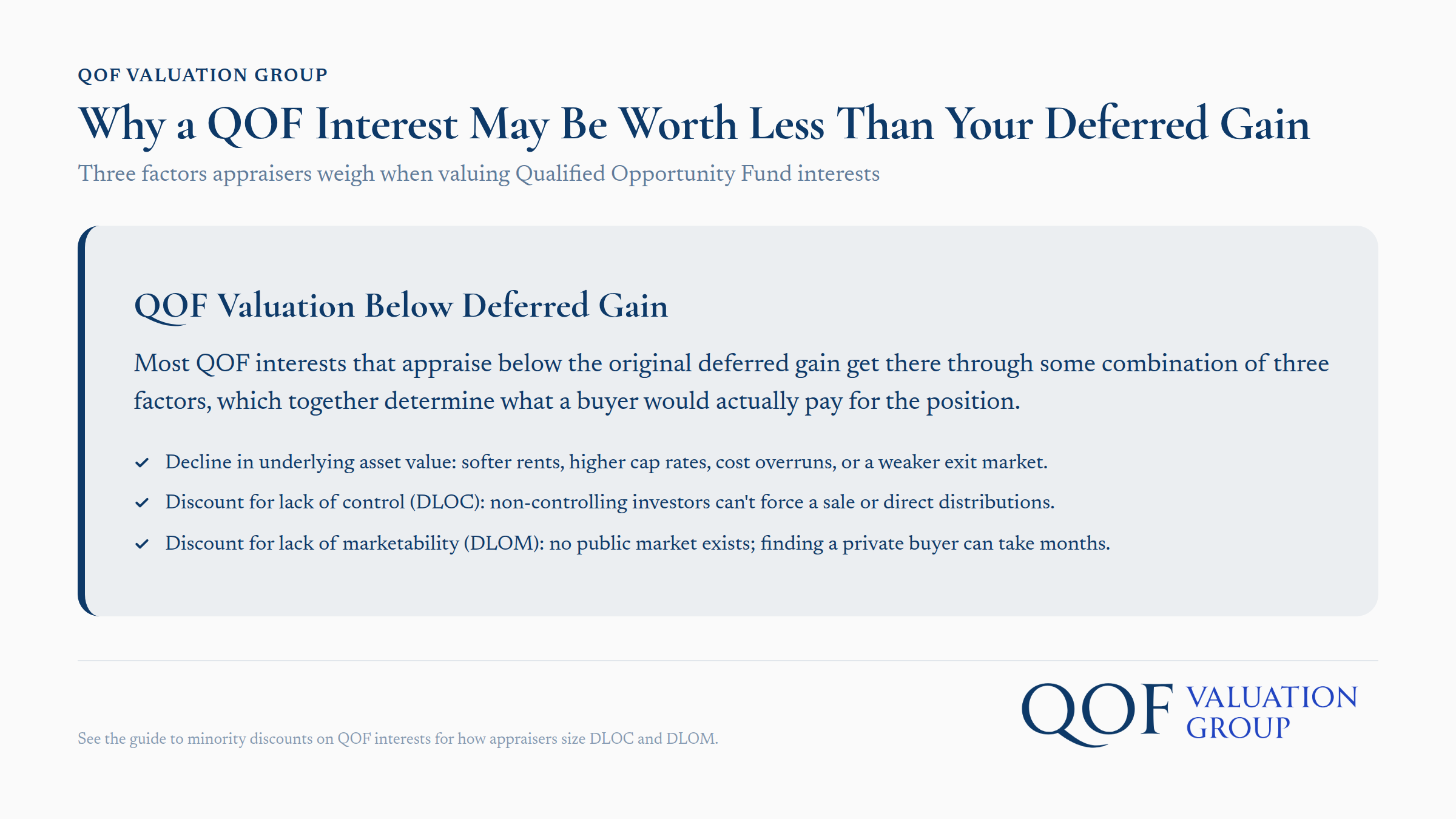
Most QOF interests that appraise below the original deferred gain get there through some combination of three factors. Understanding which ones apply to a given fund is the first step in scoping an appraisal engagement.
- Decline in the underlying asset value. If the fund's real estate or operating business is worth less today than when the capital was deployed, whether from softer rents, higher cap rates, cost overruns, or a weaker exit market, that decline flows directly through to the value of every investor's interest.
- Discount for lack of control (DLOC). Most QOF investors hold a non-controlling, non-voting interest in a partnership or LLC. A buyer purchasing that same minority position would demand a lower price than the pro rata share of the fund's total value, because the investor cannot force a sale, direct distributions, or control the timing of an exit.
- Discount for lack of marketability (DLOM). There is no public market for most QOF interests. Even a fund holding valuable, income-producing property can carry a meaningful DLOM if a buyer would need months to find, negotiate with, and close on a private seller.
Our guide to minority discounts on QOF interests walks through how appraisers size DLOC and DLOM for opportunity zone fund positions, including the data sources typically used to support each discount.
Valuing an OZ Property Still Under Construction
A large share of opportunity zone capital went into ground-up development, and many of those projects are still under construction or newly stabilized as the 2026 deadline approaches. Valuing a QOF interest tied to an unfinished project requires a different framework than valuing a stabilized asset.
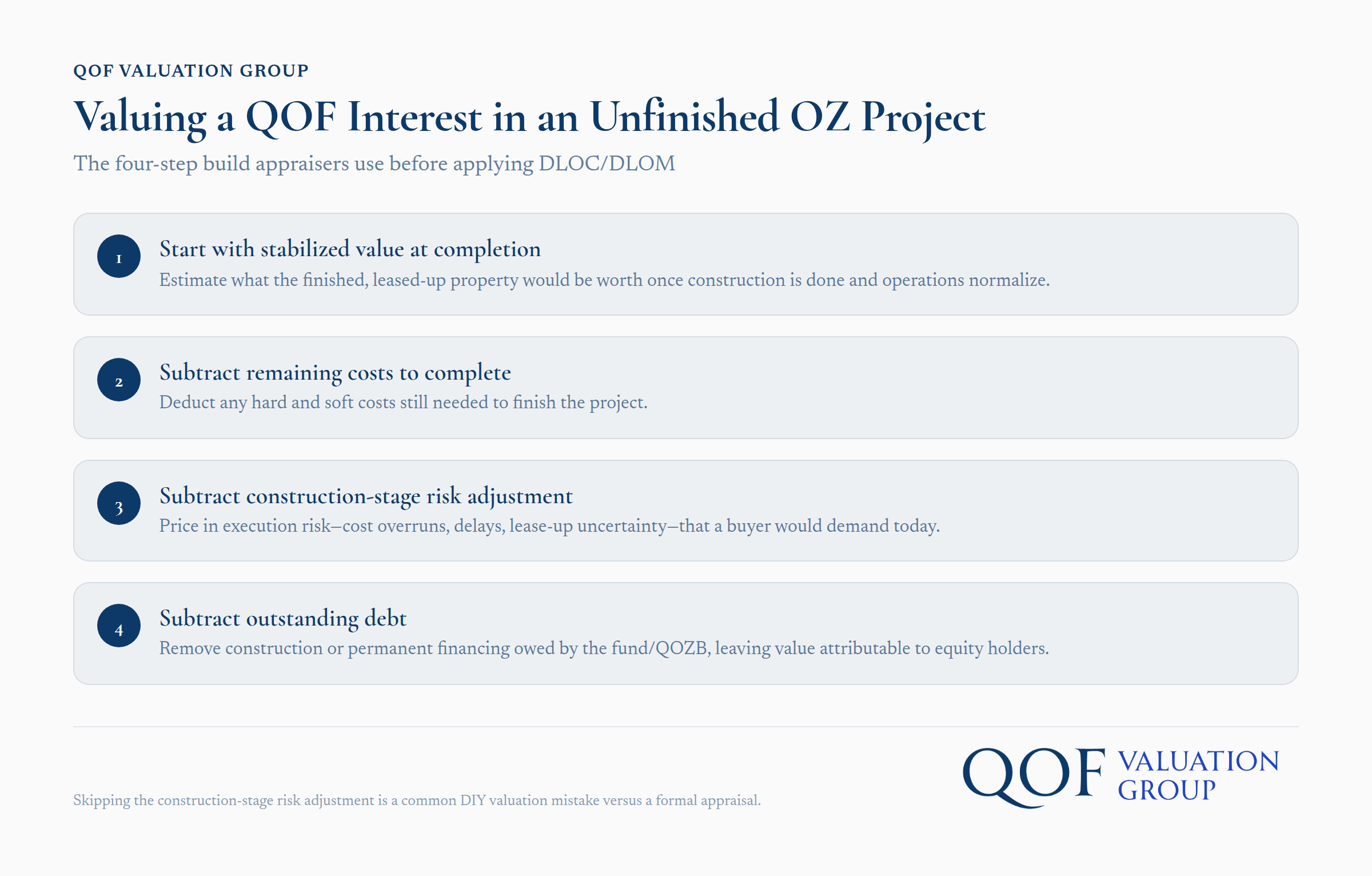
Appraisers working through construction-stage QOZ real estate typically build the value in four steps:
- Start with stabilized value at completion. The appraiser estimates what the finished, leased-up property would be worth once construction is complete and the asset reaches a normal operating level.
- Subtract the remaining costs to complete. Any hard and soft costs still needed to finish the project reduce the value available to today's investors.
- Subtract a construction-stage risk adjustment. Projects that are not yet finished carry execution risk (cost overruns, delays, lease-up uncertainty) that a buyer would price into a lower offer today, even after backing out the remaining budget.
- Subtract outstanding debt. Whatever the fund or its QOZB owes on construction loans or permanent financing comes off next, leaving the net interest value attributable to equity holders like the investor.
The result of that four-step build is the pool of value that gets allocated across the fund's equity, before DLOC and DLOM are applied to the specific interest the investor holds. Skipping the construction-stage risk adjustment is a common mistake in DIY valuations, and it is one of the reasons a formal appraisal tends to produce a materially different (and more defensible) number than a back-of-envelope estimate based on the developer's pro forma.
The Distribution Clawback: Treasury Regulation 1.1400Z2(b)-1(e)(4)
Before an investor spends money on an appraisal, there is one rule worth checking with a tax advisor first. Treasury Regulation section 1.1400Z2(b)-1, covering partnership and S corporation QOF interests, includes a "special amount includible" mechanism that can increase the inclusion amount for investors who received distributions, or loss and liability allocations, reflected on their K-1 over the life of the investment. The full regulatory text is available through Cornell's Legal Information Institute-1).
Watch out: This provision exists specifically to prevent investors from stripping cash out of a QOF through distributions and then reporting a low FMV at inclusion to avoid tax on the money they already pocketed. If an investor has received meaningful distributions, or has been allocated losses that reduced basis along the way, the special-amount-includible calculation may partially or fully offset the benefit of a lower appraised value.
This is a tax mechanics question, not a valuation question, and it should be worked through with a CPA or tax attorney before an investor commissions an appraisal. There is no reason to pay for a valuation engagement if the K-1 history means the clawback will erase most of the benefit.
Do You Need an Appraisal to Report a Lower Value?
The IRS does not require a formal appraisal to claim a QOF interest is worth less than the original deferred gain. An investor is free to report the full original gain and avoid the valuation question entirely; in that scenario, the IRS has no reason to question fair market value at all, because the taxpayer paid tax on the larger amount.
The calculus changes the moment an investor wants to report a lower, FMV-based inclusion amount. At that point, the burden is on the taxpayer to support the number if the return is ever examined, and a contemporaneous, third-party appraisal prepared by a qualified valuator is the strongest documentation available. Industry guidance on the 2026 deadline consistently emphasizes that the valuation supporting a reduced inclusion needs to be credible and well-documented, prepared before the position is taken rather than reconstructed later. A recent overview of 2026 planning steps echoes this point: the appraisal should exist by the time the return is filed, not be assembled after an audit notice arrives.
Pro tip: Have the appraisal effective date match December 31, 2026 exactly. A valuation performed weeks or months earlier or later, without an as-of adjustment, invites questions about whether it actually measures the FMV on the statutorily required date.
Worked Example: A $500,000 Deferred Gain Appraised at $340,000
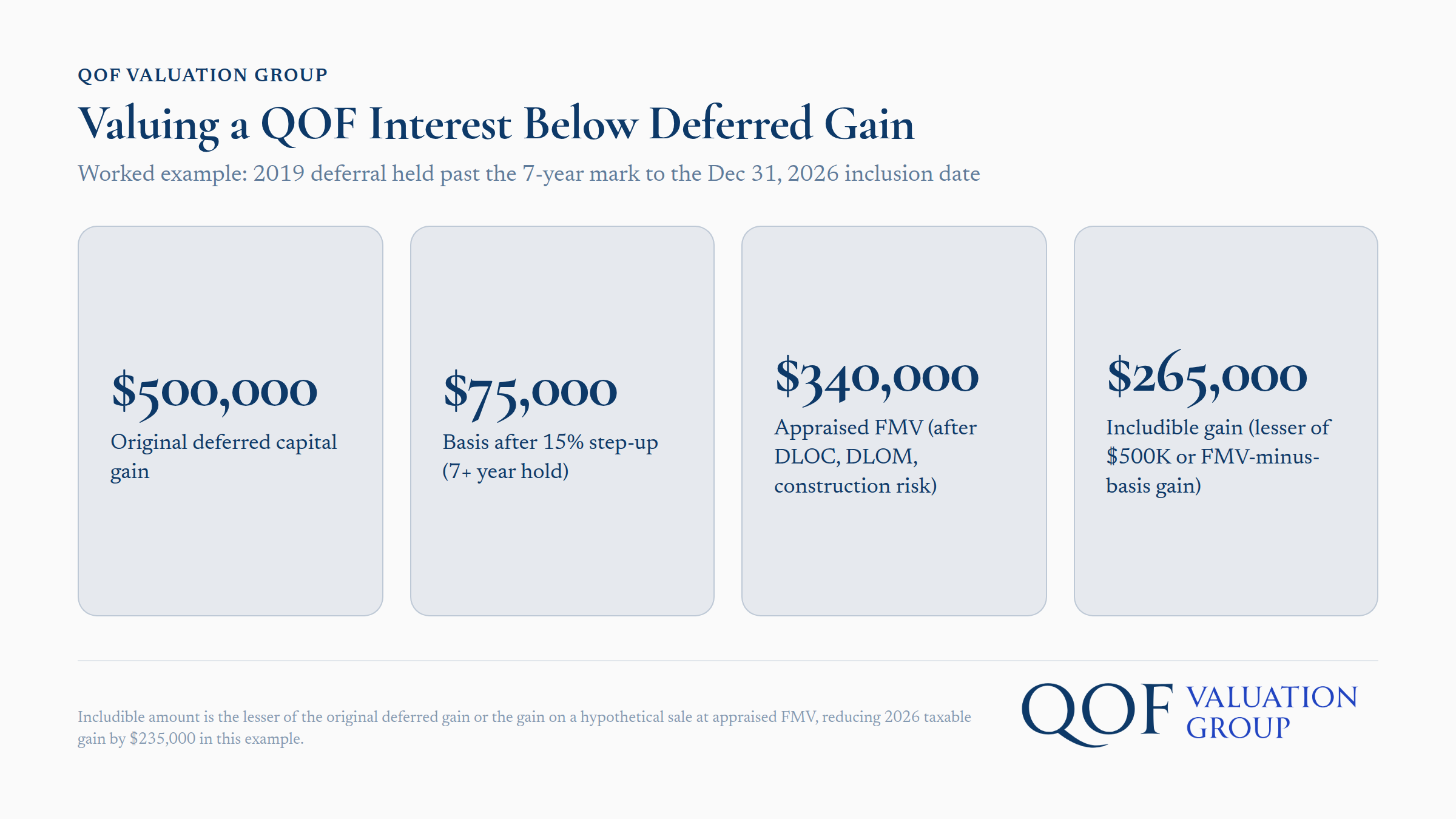
Here is how the pieces fit together for an investor who deferred a $500,000 capital gain into a QOF in 2019 and has now held the interest more than 7 years by the December 31, 2026 inclusion date.
| Step | Amount |
|---|---|
| Original deferred gain | $500,000 |
| Basis step-up (15% for 7+ year holding) | $75,000 |
| Basis in QOF interest at inclusion | $75,000 |
| Appraised FMV of QOF interest (after DLOC, DLOM, and construction-stage risk) | $340,000 |
| Gain on a hypothetical sale at FMV (FMV minus basis) | $265,000 |
| Amount includible (lesser of $500,000 or $265,000) | $265,000 |
Example: Without an appraisal, this investor would default to reporting the full $500,000 deferred gain. With a supportable FMV of $340,000, backed by an appraisal that documents the DLOC, DLOM, and construction-stage risk adjustments discussed above, the includible amount drops to $265,000, a reduction of $235,000 in taxable gain for 2026.
The Clock Is Running Out: December 31, 2026 and April 15, 2027
The inclusion event happens on December 31, 2026 regardless of when the return is filed, and the resulting tax is due with the 2026 return, generally by April 15, 2027 for individual filers (subject to extensions). An appraisal performed after that date cannot retroactively establish what a willing buyer and seller would have agreed to on December 31, 2026; it can only estimate it, with less credibility the further out it gets from the actual date.
As that date approaches, demand for qualified appraisers with QOF and QOZB experience is expected to spike, since every fund with a 2019 or 2020 vintage is facing the same deadline at once. Commentary from industry observers tracking the 2026 wind-down has noted the same trend: investors who wait until the fourth quarter of 2026 to start the valuation process risk not finding an available, qualified appraiser in time. A recent industry note on 2026 planning makes a similar point about the compressed timeline facing the broader OZ investor base.
Investors who suspect their QOF interest may be worth less than their deferred gain should start the appraisal conversation well before year-end, not in December. Between gathering the fund's financials, understanding its construction status if applicable, checking the distribution history against Treasury Regulation 1.1400Z2(b)-1(e)(4) with a tax advisor, and scheduling the appraisal itself, this is not a process that compresses well into the final weeks of the year.
Appraisal engagements for this kind of work are quoted as a fixed fee after the appraiser scopes the assignment, based on the complexity of the fund structure, the number of underlying assets, and whether the QOZB is still in a construction phase. Our appraisers prepare the fair market value documentation from start to finish, working directly with the investor and their tax advisor to build a report suitable for filing support. You can request an appraisal to start that process now, ahead of the year-end crunch.
This article is provided for general informational purposes only and does not constitute legal, tax, or financial advice. Readers should consult a qualified attorney or CPA regarding their specific circumstances.