
Blog
How the Rural Opportunity Zone Substantial Improvement Test Changes Valuation Timelines
IRS Notice 2025-50 cut the substantial improvement threshold from 100% to 50% of adjusted basis for Qualified Opportunity Zone property in rural areas, and that change compresses when fund managers need an as-is valuation, interim progress check, and post-improvement appraisal inside the 30-month window.
Fund managers and CPAs who track the Qualified Opportunity Zone substantial improvement test just got a different math problem to solve. For property located entirely within a rural Opportunity Zone, the threshold for what counts as "substantially improved" dropped from 100% to 50% of a building's adjusted basis. That single change does not just lower the capital a sponsor must spend; it shifts when valuation work needs to happen during the 30-month improvement window. Appraisers who support QOF real estate holdings are already seeing the cadence of as-is, interim, and post-improvement valuations move earlier for rural projects.
What the Rural Substantial Improvement Test Actually Requires
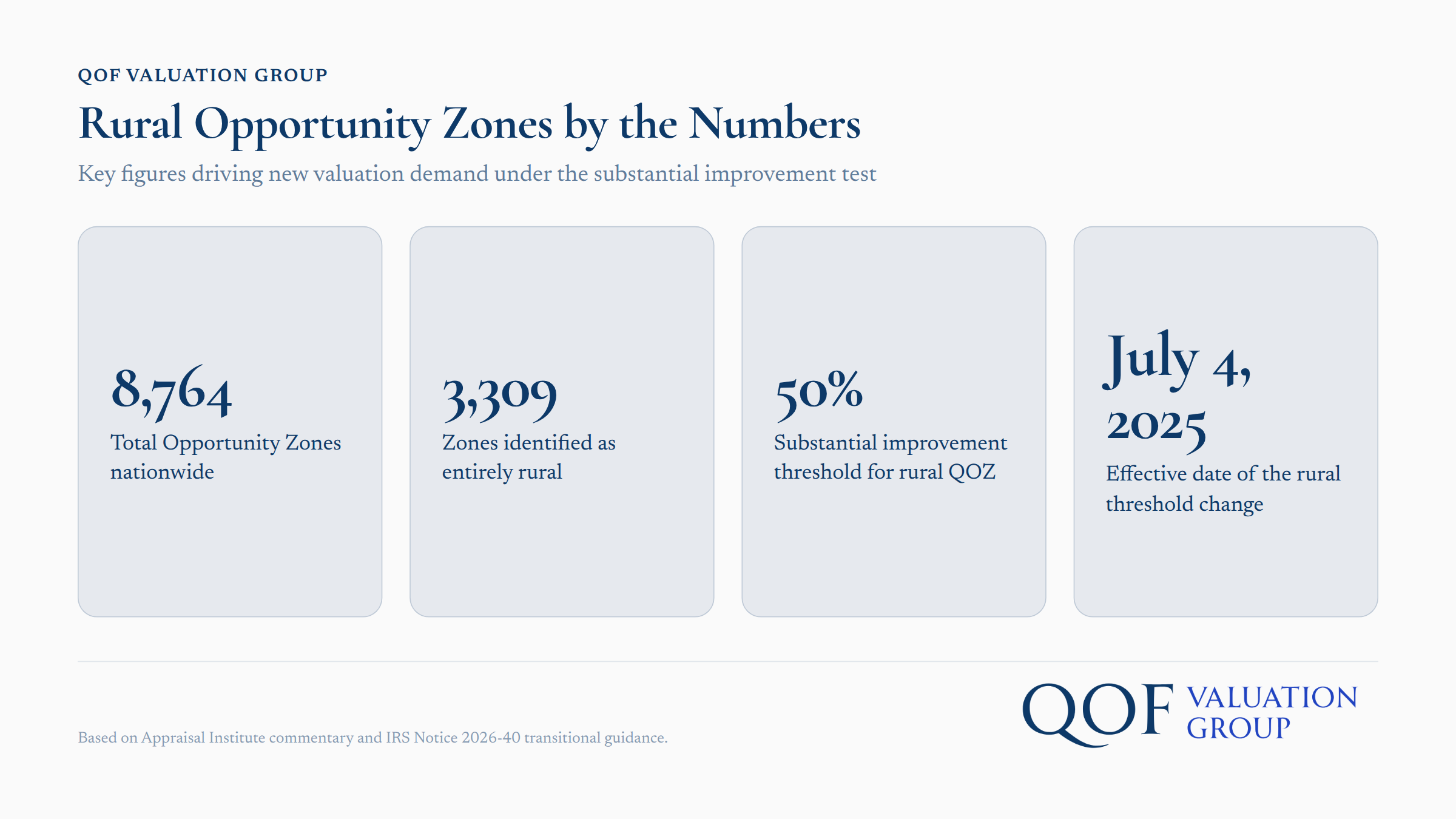
Under the standard rule, a building held by a Qualified Opportunity Fund is substantially improved only when additions to its basis during any 30-month period exceed 100% of the building's adjusted basis at the start of that period, with land excluded from the calculation. The One, Big, Beautiful Bill Act amended Internal Revenue Code Section 1400Z-2(d)(2)(D)(ii) to cut that threshold to 50% for qualifying property located in a QOZ composed entirely of a rural area, effective for property improved on or after July 4, 2025.
IRS Notice 2025-50 defines a rural area as any area other than a city or town with a population greater than 50,000, or an urbanized area contiguous and adjacent to such a city or town. The IRS has also clarified that the lower threshold applies only when the entire QOZ tract meets that rural definition, not just the parcel itself. Of the 8,764 Opportunity Zones nationwide, 3,309 have been identified as entirely rural, according to Treasury's Opportunity Zone data, which means a meaningful share of active QOF projects now qualify for the reduced standard.
The 30-month improvement window itself has not changed. What has changed is how much capital a sponsor needs to deploy inside that window, and how soon a project can reach compliance.
Standard vs Rural Threshold: A Side-by-Side Comparison
The practical difference between the two rules comes down to the denominator and the percentage applied to it. Both rules measure against the building's adjusted basis at the start of the 30-month period, excluding land, but the rural rule only requires half as much in qualifying additions.
| Factor | Standard (Non-Rural) Rule | Rural QOZ Rule |
|---|---|---|
| Basis denominator | Building's adjusted basis at start of 30-month period (land excluded) | Same: building's adjusted basis at start of 30-month period (land excluded) |
| Required threshold | Additions must exceed 100% of adjusted basis | Additions must exceed 50% of adjusted basis |
| Improvement window | 30 months beginning after acquisition | 30 months beginning after acquisition (unchanged) |
| Effective date | No change; longstanding rule | Applies to qualifying property improved on or after July 4, 2025 |
| Governing authority | IRC Section 1400Z-2(d)(2)(D)(ii) | Same statute, as amended, plus IRS Notice 2025-50 |
The updated Form 8996 instructions confirm that qualifying rural property only needs additions exceeding 50% of adjusted basis to satisfy the self-certification test, a detail funds must get right before certifying compliance on their annual filing.
Worked Example: $1,000,000 Building Basis Under Both Rules
Assume a QOF acquires a building with a $1,000,000 adjusted basis, excluding land, at the start of the 30-month improvement period. The dollar difference between the two rules is substantial.
- Standard rule: The fund must spend more than $1,000,000 on qualifying improvements within the 30-month window to satisfy the substantial improvement test.
- Rural rule: The fund must spend more than $500,000 on qualifying improvements within the same 30-month window.
Example: A sponsor redeveloping a vacant mill building in a rural QOZ with a $1,000,000 starting basis can hit the substantial improvement threshold at roughly $500,001 in qualifying capital expenditures, rather than needing to clear $1,000,001. That is half the construction budget required to reach the same compliance milestone, and it often means the project reaches that milestone many months sooner than originally scheduled.
That timing compression is the part fund managers tend to underestimate. A project budgeted for a 24-month renovation under the old assumption of needing to double its basis may now cross the compliance line at month 12 or 14, well before the original post-improvement valuation was ever scheduled.
How This Compresses the Appraisal and Valuation Cadence
Halving the capital expenditure threshold does not eliminate any step in the valuation process; it just moves the steps closer together on the calendar. Three distinct valuation touchpoints still matter for a rural QOZ project, but the gap between them can shrink considerably.
- As-Is Valuation at Acquisition
- This establishes the building's adjusted basis at the start of the 30-month clock, excluding land. Getting the land-and-improvement allocation right at this stage is what the entire substantial improvement calculation rests on later.
- Interim Valuation During the Improvement Period
- Because the rural threshold is reached with roughly half the spend, funds often need an interim check-in on construction progress and capitalized costs earlier than they would under the standard rule, particularly if draws are being tracked against a lender's or investor's reporting schedule.
- Post-Improvement Valuation
- Once qualifying additions exceed 50% of the starting adjusted basis, the project has met the statutory test. A post-improvement valuation documenting the completed basis allocation and the property's improved condition may be needed sooner than a sponsor originally planned, especially if the fund intends to report completion well ahead of the 30-month deadline.
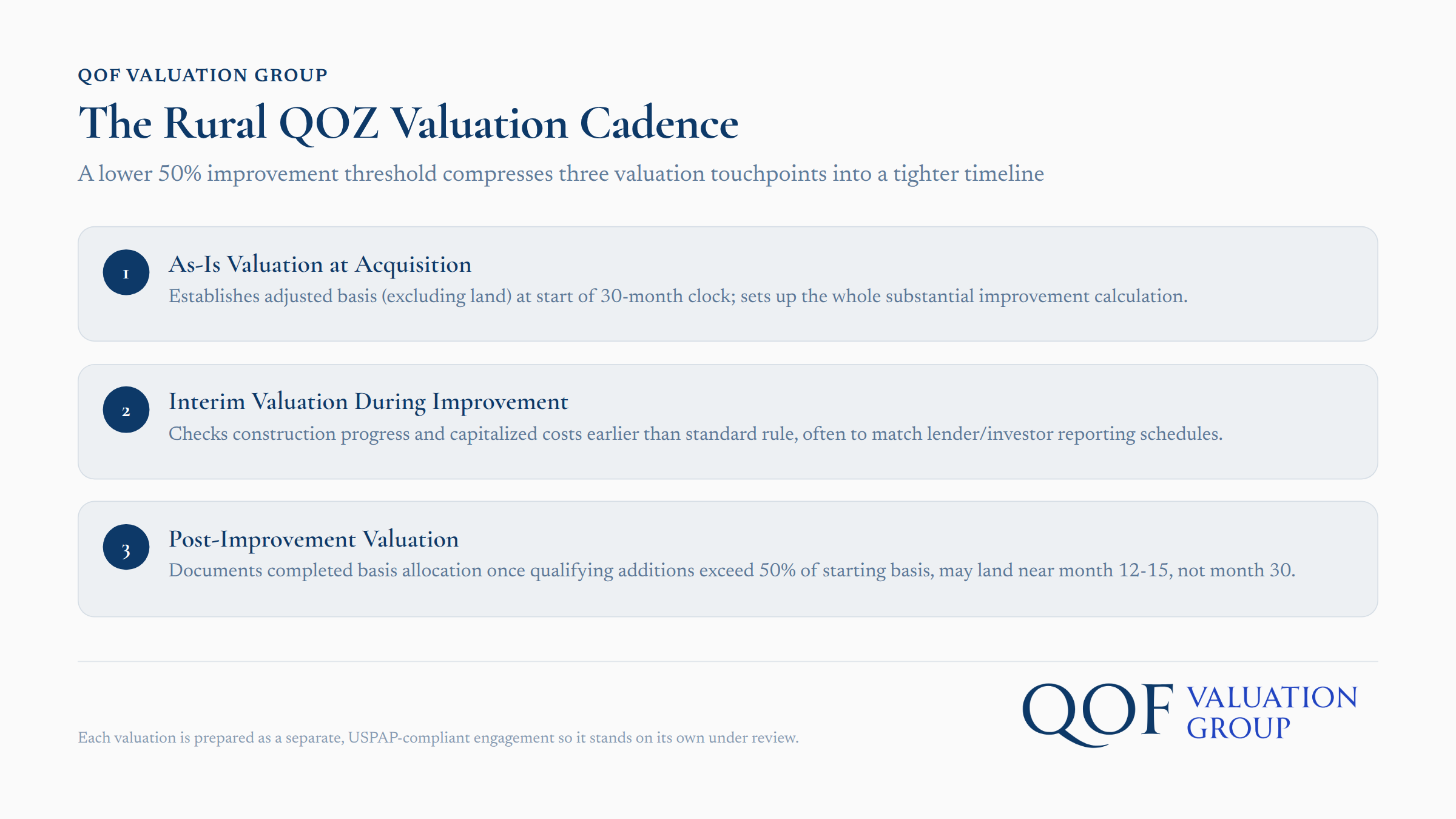
A sponsor who planned a single valuation at the 30-month mark under the old assumption may now need that work scheduled closer to month 12 through 15, depending on construction pace. Our team prepares the as-is and post-improvement valuations as separate, USPAP-compliant engagements so each one stands on its own if a fund's documentation is ever reviewed.
Why the Appraisal Institute Has Flagged Rising Demand for Valuation Work
The Appraisal Institute has noted that the rural substantial improvement change, combined with the move toward a permanent Opportunity Zone program, is generating new categories of valuation demand beyond the basic compliance check. Four types of engagements come up most often for rural QOZ sponsors:
- As-is valuations that establish a defensible starting basis before the 30-month clock begins running.
- Land and improvement basis allocations, since the substantial improvement test excludes land and an incorrect allocation can overstate or understate the required spend.
- Redevelopment feasibility analysis, which helps a sponsor confirm a project can realistically clear the 50% threshold within budget before committing capital.
- Portfolio-level valuation, as funds holding multiple rural properties need consistent methodology across sites for investor reporting and annual self-certification.
The transition toward what the industry calls OZ 2.0 adds another layer. Transitional guidance under IRS Notice 2026-40 points toward Opportunity Zones becoming a permanent, recurring program starting in 2027 rather than a one-time designation tied to the 2017 tax law. Funds anticipating rolling QOZ designations will likely need repeatable valuation processes rather than a one-off engagement, which is part of why portfolio-level work is becoming more common for QOF real estate holdings and for property contributed directly into a fund, which carries its own valuation requirements at the time of contribution.
What This Means for Fund Managers and CPAs Right Now
The rural 50% rule is a tax-basis test, not a market-value test. Meeting it depends on the dollar amount of qualifying additions to basis measured against a specific starting point, and an appraisal supports that calculation by documenting the starting basis, the land and improvement split, and the completed scope of work. An appraisal alone does not satisfy the statutory test, and no valuation report can guarantee how the IRS will treat a fund's self-certification on Form 8996.
For sponsors and their CPAs, the practical takeaway is to build the valuation schedule around the rural threshold from day one rather than defaulting to a 30-month timeline inherited from the standard rule. Our appraisers prepare USPAP-compliant as-is, interim, and post-improvement valuations that document basis allocation at each stage, giving fund managers a defensible paper trail regardless of how quickly a rural project crosses the 50% line.
If your fund holds property in a QOZ that may qualify as entirely rural, now is the time to confirm the tract's classification and re-check your construction budget against the lower threshold. Our team can prepare an appraisal that establishes your starting basis and supports your fund's documentation through completion.
This article is provided for general informational purposes only and does not constitute legal, tax, or financial advice. Readers should consult a qualified attorney or CPA regarding their specific circumstances.