
Blog
When Does a QOF Need a Valuation for a Property Contribution?
Contributing a building or business interest to a Qualified Opportunity Fund instead of cash caps gain deferral at the lesser of basis or fair market value, which means the fund needs a defensible valuation before the deal closes. This guide walks through the IRS rules that trigger a QOF property contribution valuation and the related-party threshold that raises the stakes.
Most Qualified Opportunity Fund investors write a check. But funds and the businesses they hold regularly receive non-cash contributions instead: a piece of real estate, an operating business interest, equipment already sitting on a company's books. The moment a contribution isn't cash, the rules that cap gain deferral and the rules that govern the fund's asset tests both hinge on a number that never appears on a closing statement: fair market value.
This is written for QOF sponsors, fund administrators, and the CPAs and attorneys advising investors who are structuring one of these contributions. It is not a general primer on Opportunity Zones; it answers a narrower, more practical question: when does a property contribution actually require a formal valuation, versus when can the fund rely on basis or book value instead? Our business valuation team prepares independent, USPAP-compliant fair market value appraisals for exactly these situations, and the mechanics below reflect the same analysis we run for clients before a contribution closes.
Why a Non-Cash Contribution Triggers a Valuation Question
A taxpayer who contributes cash to a QOF defers gain dollar for dollar, up to the amount invested. A taxpayer who contributes property instead does not get that same simple math. Under the IRS's own guidance, when a taxpayer contributes property (rather than cash) to a QOF in exchange for an equity interest, the amount treated as a qualifying investment is capped at the lesser of the taxpayer's adjusted basis in the contributed property or the fair market value of the QOF interest received in the exchange, as described in the IRS Opportunity Zones FAQ.
That "lesser of" test cannot be applied without knowing both numbers. Basis is usually easy to document from the contributor's own records. Fair market value is not. If the fund and the contributor simply assume the two numbers are equal, or skip the comparison entirely, the qualifying investment amount is unsupported, and so is every downstream calculation that depends on it: the deferred gain, the eventual basis step-up, and the amount that must be included in income when the deferral period ends.
The QOZ Business Property Purchase Requirement
A second, separate problem shows up on the fund's own asset tests. To count as qualified opportunity zone business property, an asset generally must have been purchased by the QOF or the QOZ business after 2017, in an arm's-length transaction for money or money's worth. Property contributed to the fund through a non-recognition transaction, such as a section 351 exchange for corporate stock or a section 721 contribution to a partnership, typically was not "purchased" in that sense.
That matters because the fund still has to run its 90% asset test (and QOZ businesses run a related 70% test) using a value for every asset it holds. The IRS Form 8996 instructions and the underlying Treasury regulations on the 90% investment standard-1) allow a fund to value its assets under a financial statement method or an alternative method based on original cost, which for purchased property is straightforward. Contributed property that fails the purchase test cannot simply carry over its contributor's cost basis as if that were a purchase price; the fund needs a defensible fair market value figure to support how that asset is being counted, both for the initial testing date and for every semiannual test afterward. Our guide to Form 8996 self-certification and the 90% asset test covers the mechanics of that test in more depth.
Related-Party Contributions Face a Lower Ownership Threshold
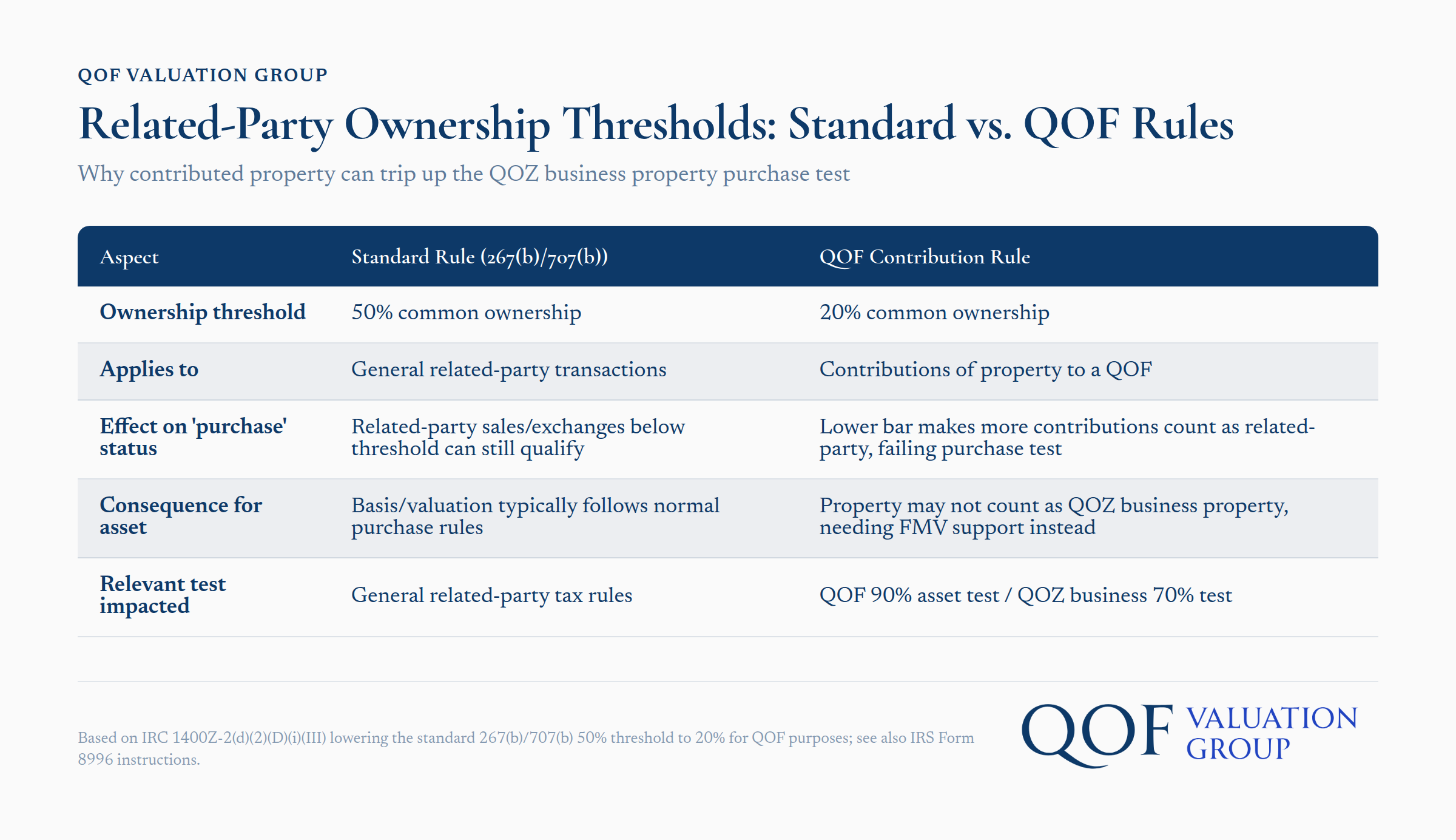
A contribution from someone who already owns a stake in the fund or the underlying business draws extra scrutiny, and the bar for "related" is lower here than in most of the tax code. Standard related-party rules under sections 267(b) and 707(b) generally use a 50% ownership threshold to determine whether two parties are related. The Opportunity Zone statute changes that threshold specifically for QOF purposes, replacing it with a 20% ownership test, a modification that final regulations and industry commentary on the second round of qualified opportunity fund regulations walk through in detail.
Practically, that means a founder, a general partner, or an affiliated entity that holds a 20% or greater interest in the QOF or the QOZ business cannot contribute a building, equipment, or a business interest to that same fund and rely on an informal, self-assessed value. Any contribution priced above or below a defensible fair market value, in either direction, looks like an attempt to manufacture qualifying investment amount or shift deferred gain, which is precisely the kind of transaction the lower threshold was designed to catch. An independent appraisal, prepared by someone with no stake in the outcome, is the practical way to document that the contribution was priced at arm's length.
Watch out: the 20% threshold applies to related-party transfers generally under the Opportunity Zone rules, not just to the specific contribution scenario above. Redemptions, related-party leases, and related-party service arrangements involving the fund can all be swept into the same lower bar.
Worked Example: Contributing a Building With Basis Below FMV
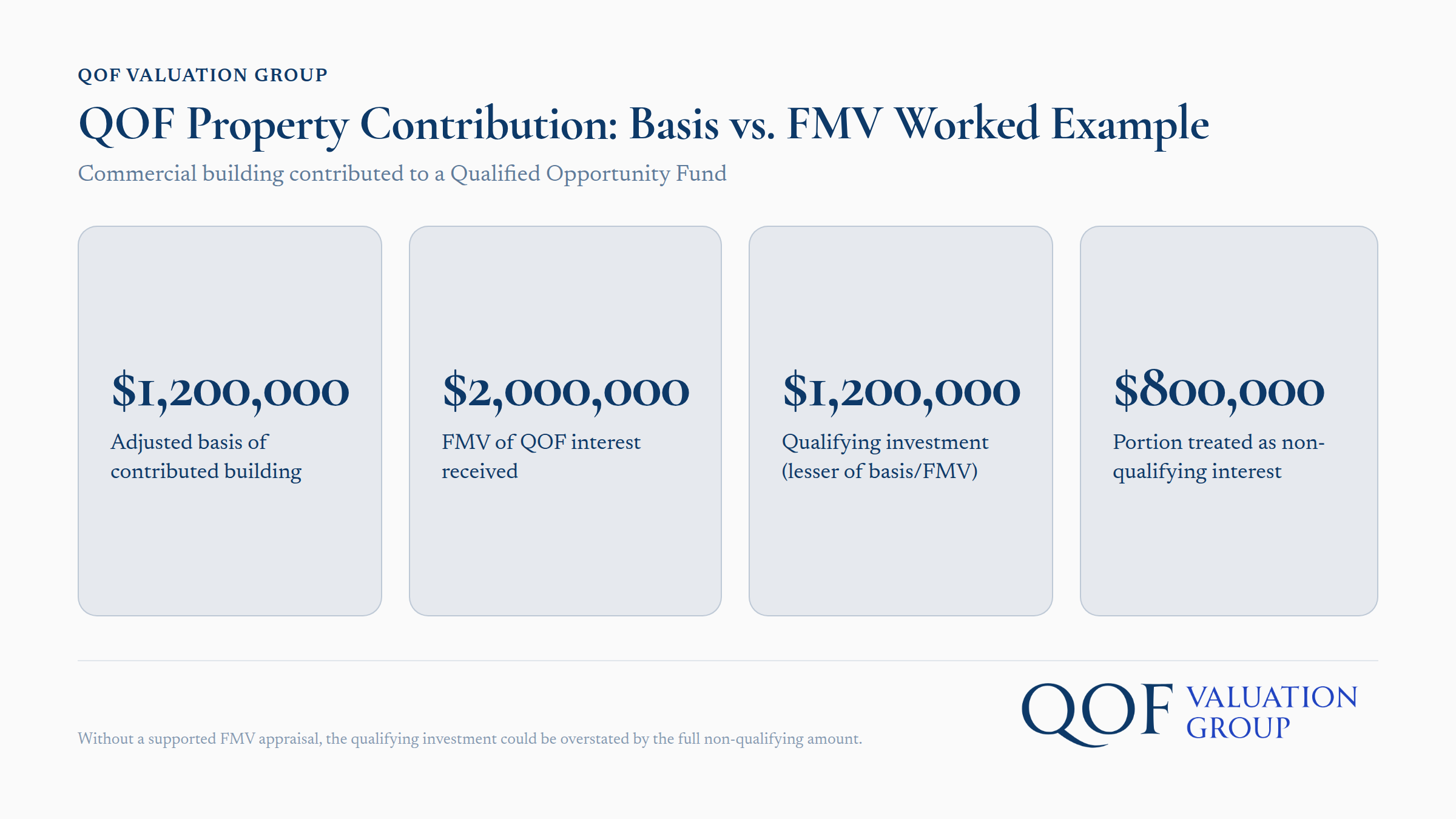
Here is how the basis-versus-FMV cap plays out with real numbers. Assume an investor holds a commercial building with an adjusted basis of $1,200,000. The building's current fair market value is $2,000,000, and the investor contributes it to a QOF in exchange for a fund interest.
- Adjusted basis of the contributed property: $1,200,000
- Fair market value of the QOF interest received: $2,000,000
- Qualifying investment amount (the lesser of the two): $1,200,000
- Portion of the interest treated as non-qualifying: $800,000
Only $1,200,000 of the investor's stake qualifies as a QOF investment eligible for gain deferral treatment. The remaining $800,000 of value received is not a qualifying investment, which means the fund now holds what the regulations describe as a mixed-use interest for that investor: part of the equity carries the deferral and step-up benefits, and part does not.
None of that split can be calculated without a supported fair market value for the building at the contribution date. If the fund had instead assumed the building's basis and FMV were the same, it would have overstated the qualifying investment by $800,000, an error that would surface the moment the IRS or an investor's own advisor asked for the appraisal behind the number.
When Cash Contributions Skip the Valuation Requirement
Cash contributions avoid nearly all of this. A cash investment into a QOF is measured at its face amount; there is no basis-versus-FMV comparison to run because basis and value are identical for cash. On the fund's side, cash received and held in cash or cash equivalents within the six months before a testing date can be excluded from both the numerator and denominator of the 90% asset test, a relief provision described in the IRS FAQ on Opportunity Zone investments. That exclusion applies strictly to cash. The moment a fund converts that cash into real property, equipment, or a business acquisition, the asset must be valued and counted like any other QOF asset.
Key takeaway: the valuation requirement is not about the dollar size of the contribution. It is triggered by the form of the contribution. Cash in, cash held, cash deployed through an arm's-length purchase: no separate appraisal question. Property in, whether through a section 351 or 721 transfer or a related-party transaction: a fair market value determination becomes part of the compliance file.
What a Defensible Valuation Actually Documents
A property contribution valuation for QOF purposes generally applies the same recognized approaches used in other fair market value work: the income approach (often a discounted cash flow or capitalization of stabilized net operating income for real estate), the sales comparison approach, and the cost approach where replacement cost is the more relevant measure. Industry guidance on reducing deferred gain with valuation discounts ties the fair market value standard applied to QOF interests directly back to the classic definition: the price at which property would change hands between a willing buyer and a willing seller, neither under compulsion and both reasonably informed. Our earlier piece on why Rev. Rul. 59-60 still governs QOF interest valuation today covers that standard in more detail.
For a building still under construction or lease-up, the analysis typically layers in a stabilized value estimate, then backs out remaining costs to completion and a risk adjustment for construction-stage uncertainty, before subtracting outstanding debt to reach the net value of the ownership interest actually being contributed. That layered approach is why these engagements are scoped as appraisals, not desk reviews: the underlying asset's stage of development changes the analysis materially.
Who Orders the Appraisal and What It Costs
The contributing investor, the fund sponsor, or the CPA coordinating the transaction can order the valuation, but it should always come from a party independent of the contribution itself, particularly given the 20% related-party threshold discussed above. Credentialed business appraisers holding designations from organizations such as the ASA (American Society of Appraisers) or NACVA typically perform this work, applying USPAP as the underlying reporting standard regardless of which specific valuation approach the assignment calls for.
Fees for a QOF property contribution valuation are quoted as a fixed fee after we scope the assignment, never billed hourly. As a general reference point, our business valuation engagements start at $4,500 for standard reporting and $5,500 for IRS-qualified appraisals, with most engagements in the $7,500 to $12,000 range depending on the number of assets involved, the completeness of the underlying records, and whether the report needs to withstand IRS or related-party scrutiny. A single building contribution with clean records sits at the lower end of that range; a multi-asset business interest contribution with debt, leases, and construction-stage assumptions sits at the higher end.
Getting the valuation right before the contribution closes is far cheaper than reconstructing one after the fact, once the qualifying investment amount, the 90% test result, or a related party's basis is already locked into a filed return.
This article is provided for general informational purposes only and does not constitute legal, tax, or financial advice. Readers should consult a qualified attorney or CPA regarding their specific circumstances.