
Blog
Rev. Rul. 59-60 and Why it Still Governs QOF Interest Valuation Today
Revenue Ruling 59-60 set the IRS framework for fair market value in 1959, and it still controls how appraisers value Qualified Opportunity Fund interests today. This guide walks through the eight-factor test, the discounts it implies, and how they shape the stepped-up basis under a 10-year QOF election.
A QOF investor who holds a qualifying investment for at least 10 years can elect to step up basis to fair market value on the date of sale or exchange. That single sentence hides a hard valuation question: fair market value of what, exactly, and according to whose standard? The answer traces back to a 1959 revenue ruling written for estate and gift tax purposes, and it still shapes how our qualified opportunity fund valuation team approaches every QOF interest we appraise.
This piece walks through Revenue Ruling 59-60, the eight factors it requires an appraiser to weigh, how its language on block size anticipated the discounts used in every QOF interest valuation today, and why the number that lands in a Section 1400Z-2(c) election is rarely the same as an investor's simple pro-rata share of the fund.
What Revenue Ruling 59-60 Actually Established
Revenue Ruling 59-60 (1959-1 C.B. 237) is the IRS's foundational guidance for valuing closely held business interests when no active public market exists to set a price. It was written to address stock in closely held corporations for estate and gift tax purposes, but its reach quickly grew beyond that.
The ruling defines fair market value in language that still appears, almost word for word, in valuation reports written today: the price at which property would change hands between a willing buyer and a willing seller, neither being under any compulsion to buy or sell, and both having reasonable knowledge of relevant facts. That single sentence is the standard every subsequent business and fund valuation, including a QOF interest, has to satisfy.
Industry commentary describes Rev. Rul. 59-60 as the foundation of modern valuation practice precisely because it never restricts itself to corporate stock. Its approach and factors are treated as equally applicable to income tax valuations and to business interests of any type, which is exactly the doctrinal bridge that lets appraisers apply a 1959 estate-tax ruling to a 2026 partnership interest in an opportunity zone fund.
The Eight Factors an Appraiser Must Weigh
Rev. Rul. 59-60 does not hand appraisers a formula. It hands them a checklist of factors that must all be considered together, with the weight given to each one depending on the facts of the specific engagement. The ruling's text, still cited in valuation literature discussing closely held and partnership interests, lists these factors:
- Nature and history of the business: its formation, ownership structure, and stage of development.
- Economic outlook: the general economy and the specific outlook for the industry the business operates in.
- Book value and financial condition: balance sheet strength, leverage, and liquidity.
- Earning capacity: historical and prospective earnings, often the single most significant factor for an operating business.
- Dividend-paying capacity: the ability to generate distributable cash, whether or not distributions are actually made.
- Goodwill and intangible value: brand strength, customer relationships, and other value beyond tangible assets.
- Prior sales and block size: arm's-length transactions in the company's stock and the size of the specific interest being valued.
- Comparable market prices: trading multiples of publicly held companies in the same or a similar line of business, adjusted where needed.
No single factor controls the outcome. The ruling itself treats valuation as a question of fact that depends on the circumstances of each case, and courts continue to lean on that framework: a recent federal appellate brief in Gross v. Commissioner still cites the fact-intensive, no-single-formula nature of business valuation that Rev. Rul. 59-60 established.
Key takeaway: a defensible QOF interest valuation has to walk through all eight factors as they apply to the fund's underlying assets, its distribution history, and its remaining opportunity zone compliance period, not just plug numbers into a single formula.
Block Size, Minority Interests, and the Roots of DLOC and DLOM
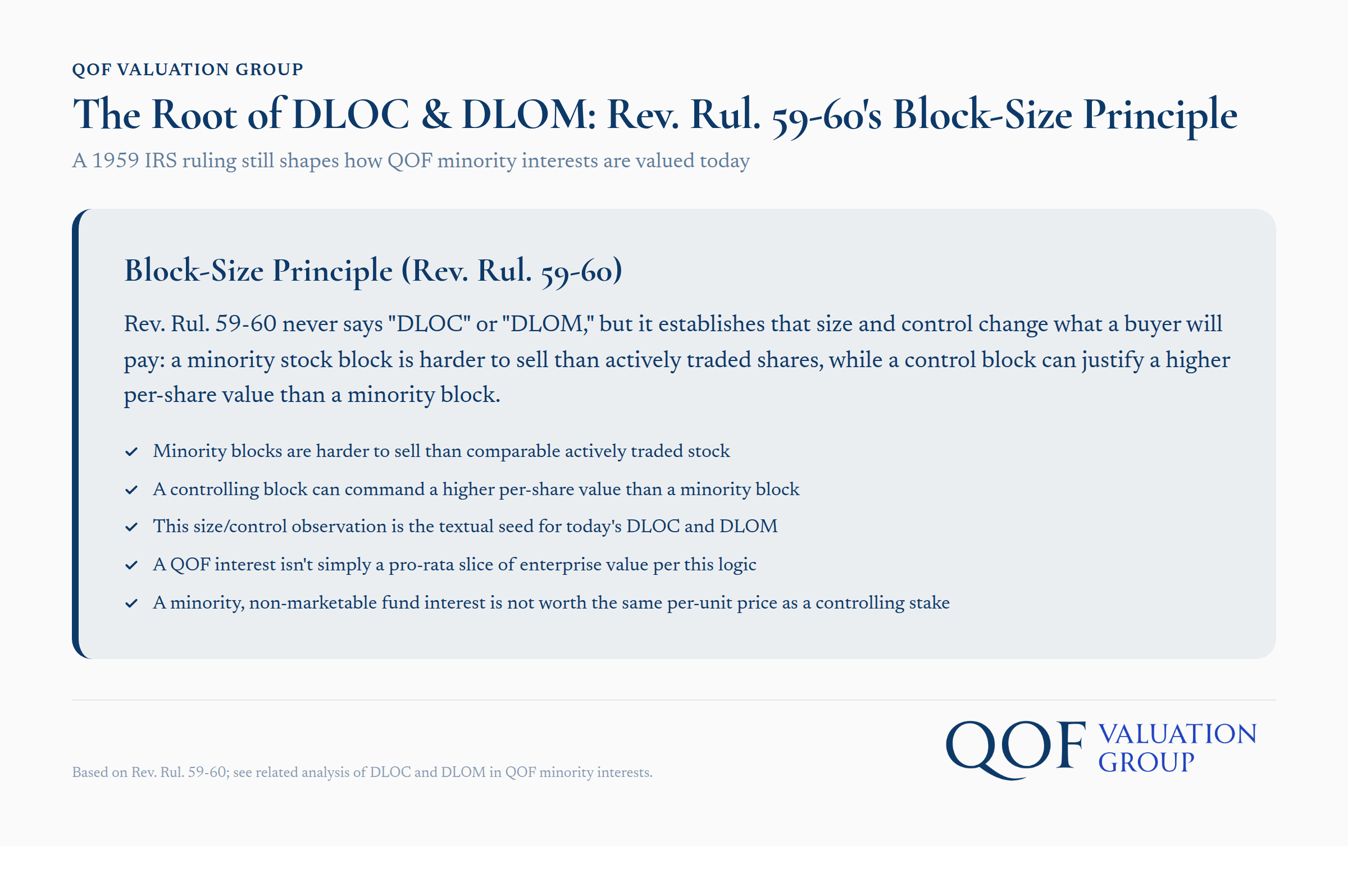
Rev. Rul. 59-60 never uses the terms discount for lack of control (DLOC) or discount for lack of marketability (DLOM). Those labels came later. But the ruling's text on block size is where the underlying logic starts.
The ruling recognizes that a minority block of stock is harder to sell than a comparable amount of actively traded stock, while a block large enough to carry control can justify a higher value per share than a minority block would receive. That single observation, that size and control change what a willing buyer will actually pay, is the textual seed for both discounts appraisers apply today. Our analysis of DLOC and DLOM in QOF minority interests covers how those discounts are quantified in practice.
Watch out: treating a QOF interest as simply "10% of enterprise value" skips the exact factor Rev. Rul. 59-60 flagged more than 60 years ago. A minority, non-marketable interest in a fund is not worth the same per-unit price as a controlling stake, and the IRS's own foundational guidance says so directly.
Why the QOF Basis Step-Up Turns on the Interest, Not the Enterprise
Under IRC Section 1400Z-2(c), an investor who holds a qualifying QOF investment for at least 10 years may elect to step up basis to the fair market value of the QOF interest on the date of sale or exchange, not to a simple pro-rata share of the fund's total assets. For a QOF structured as a partnership, that fair market value basis also has to account for the investor's share of QOF liabilities, calculated in a manner similar to a partnership basis adjustment under the tax code.
That distinction matters enormously. Enterprise value and the fair market value of a specific investor's interest are two different numbers, and Rev. Rul. 59-60's eight factors, plus its block-size logic, are exactly what separates one from the other. An investor weighing the 10-year election needs an appraisal of the interest itself, not a back-of-envelope percentage of the fund's balance sheet.
A Worked Example: From $10 Million Pro Rata to a $7 Million Stepped-Up Basis
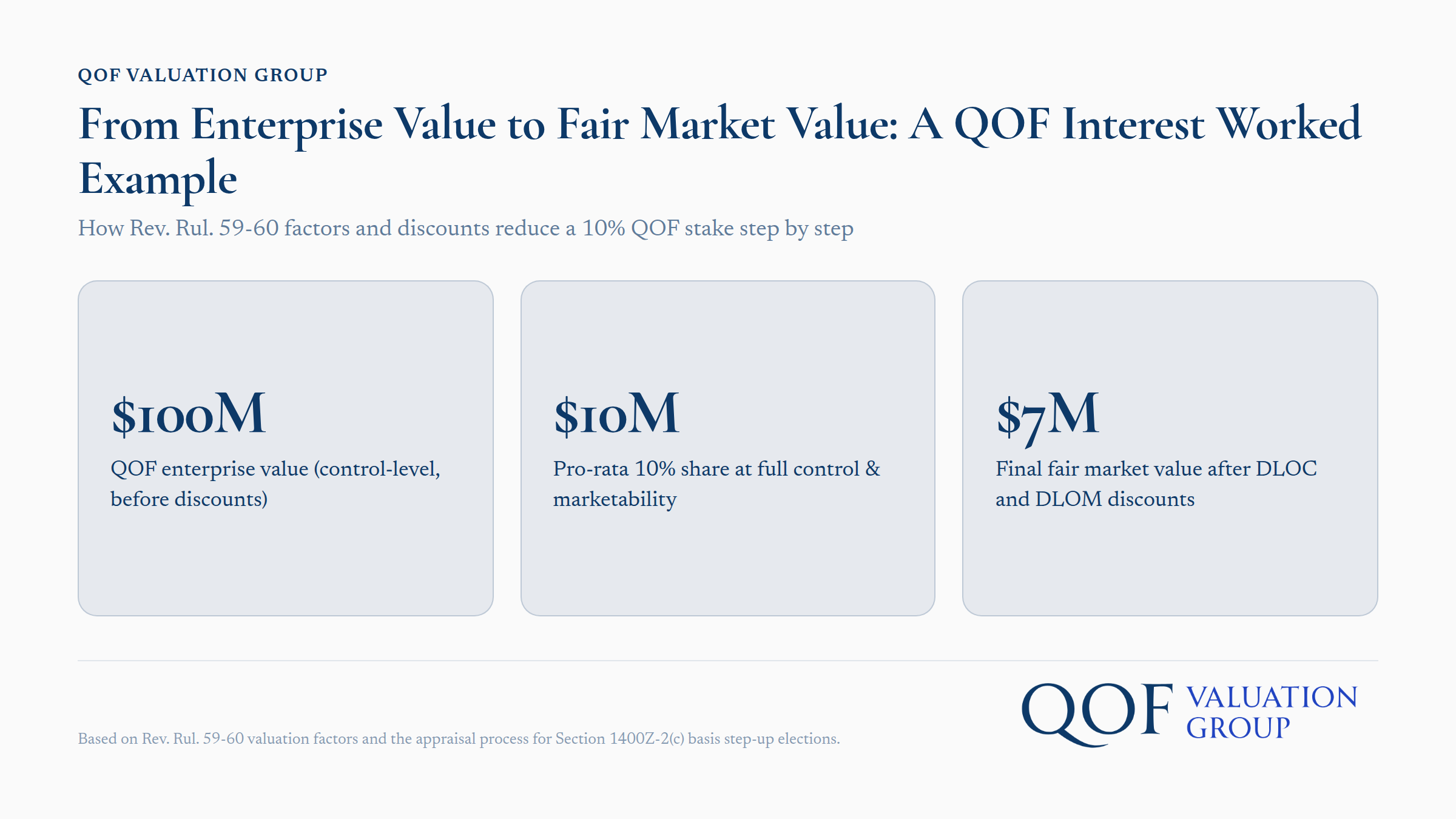
Consider a QOF with an enterprise value of $100 million, where an investor holds a 10% limited partnership interest. A purely mathematical pro-rata share would put that interest at $10 million.
But a pro-rata share assumes control-level pricing, and a 10% limited partner has neither control over fund decisions nor a ready market to sell into. After applying a discount for lack of control and a discount for lack of marketability, a hypothetical willing buyer might reasonably pay $7 million for that same interest.
| Valuation Step | Amount |
|---|---|
| QOF enterprise value | $100,000,000 |
| Investor's pro-rata share (10%) | $10,000,000 |
| After DLOC and DLOM | $7,000,000 |
| Fair market value used for basis step-up | $7,000,000 |
The stepped-up basis under the Section 1400Z-2(c) election is $7 million, not $10 million, because the statute steps basis up to the fair market value of the interest the investor actually holds. Skipping the discount analysis and using the pro-rata figure would overstate basis by $3 million on this single investment.
How Appraisers Actually Value a QOF Interest
A rigorous QOF interest appraisal does not start and end with a single number. It works through the fund and the interest in sequence.
- Value the enterprise using the Rev. Rul. 59-60 factors. The appraiser reviews the fund's underlying opportunity zone assets, financial condition, earning and distribution capacity, and comparable market data to reach a control-level enterprise value.
- Calculate the pro-rata control value. The investor's ownership percentage is applied to the enterprise value to establish what the interest would be worth if it carried full control and full marketability.
- Apply a discount for lack of control. The appraiser adjusts for the investor's limited or absent voting and management rights within the fund.
- Apply a discount for lack of marketability. The appraiser adjusts further for the absence of a ready market and the fund's remaining holding period restrictions.
- Conclude the fair market value of the specific interest. The result is the number that supports a basis step-up election, an estate filing, or a buy-sell transaction, not the undiscounted pro-rata figure.
Pro tip: ask any appraiser proposing to value your QOF interest which step they treat as the deliverable. If the answer stops at step 2, the report is missing the exact analysis Rev. Rul. 59-60 requires and the exact figure the Section 1400Z-2(c) election depends on.
What This Means for CPAs, Fund Sponsors, and Investors
For a CPA advising a client on the 10-year election, the practical implication is straightforward: request a fair market value appraisal of the specific interest, documented against Rev. Rul. 59-60's eight factors, before filing a return that relies on a stepped-up basis. For a fund sponsor, the same analysis supports capital account reporting and buy-sell agreements among limited partners. For an investor, it is the difference between a defensible basis figure and one that invites IRS scrutiny.
Our team prepares these valuations as a fixed fee quoted after we scope the fund's structure, asset mix, and the size of the interest being valued; engagements are never billed hourly. If you are approaching a 10-year holding anniversary or evaluating an early sale, request an appraisal and we will walk you through what the engagement requires.
This article is provided for general informational purposes only and does not constitute legal, tax, or financial advice. Readers should consult a qualified attorney or CPA regarding their specific circumstances.