
Blog
What Is a Qualified Opportunity Zone Fund and How Does It Work?
A qualified opportunity zone fund is a corporation or partnership that self-certifies with the IRS to hold at least 90% of its assets in opportunity zone property, unlocking capital gains deferral in exchange for a strict compliance regime. This guide breaks down the statutory requirements, the 90% asset test, and why the deferred gain inclusion event eventually requires a defensible fair market value appraisal.
What Is a Qualified Opportunity Zone Fund?
A qualified opportunity zone fund (QOF) is an investment vehicle, organized as a corporation or partnership, formed for the specific purpose of investing in qualified opportunity zone property. Under IRC Section 1400Z-2(d)(1)-1), a QOF must hold at least 90% of its assets in that property, and it becomes a QOF not through IRS approval but through annual self-certification.
That single fact surprises a lot of investors: there is no application, no license, and no government review board that blesses a fund as a QOF. The entity simply files IRS Form 8996 with its timely filed federal tax return and elects QOF status for a chosen tax year. Everything downstream, the deferral, the basis step-up, the eventual exclusion, depends on that fund actually meeting the substantive tests year after year.
The Statutory Requirements Behind the QOF Label
To qualify and stay qualified, a fund has to clear a few structural hurdles before the tax benefits even come into play.
- Entity type: The fund must be organized as a corporation or partnership (including an LLC taxed as one of those) under the laws of a U.S. state, D.C., a U.S. territory, or a federally recognized tribal government, according to IRS guidance on certifying and maintaining a QOF.
- Stated purpose: The organizing documents must reflect that the entity exists to invest in qualified opportunity zone property, not as an incidental activity.
- No fund-of-funds structure: A QOF must invest in opportunity zone property itself, not merely hold interests in another QOF.
- Annual self-certification: The fund files Form 8996 every year it wants to maintain QOF status, reporting whether it met the 90% asset test for that tax year.
A qualified opportunity zone, for context, is a low-income census tract nominated by a state or territory and certified by the U.S. Treasury Department. The zones themselves are the geography; the QOF is the legal vehicle investors actually put money into, and it's the only door through which an investor reaches the tax incentives tied to those zones, per the IRS Opportunity Zones FAQ. If you're still mapping out which census tracts qualify, our guide on how to qualify for a QOZ covers the designation criteria in more depth.
How the 90% Asset Test Works
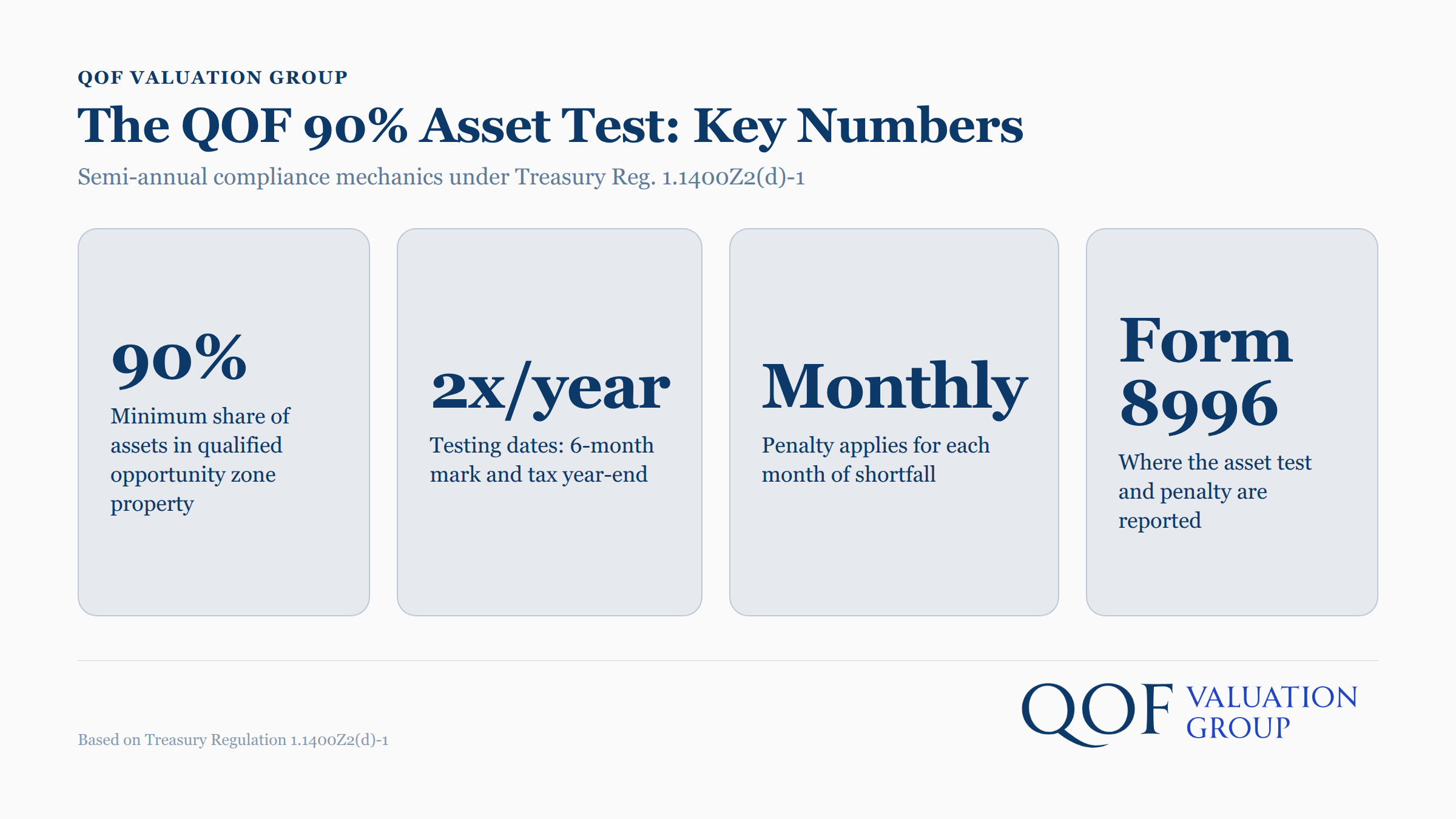
A QOF must hold at least 90% of its assets in qualified opportunity zone property, tested twice a year rather than once. Treasury Regulation 1.1400Z2(d)-1-1) requires the fund to average two measurements: the last day of the first six-month period of its tax year, and the last day of the tax year itself. Miss the threshold on either date and the fund faces a monthly penalty tied to the size of the shortfall, assessed on Form 8996.
Qualifying property generally falls into two buckets: qualified opportunity zone business property held directly, or equity interests (stock or partnership interests) in a qualified opportunity zone business that itself meets the operating requirements. Property the fund already owned before certifying as a QOF generally doesn't count toward the 90% test; the property has to be new to the fund's opportunity zone activity. Tangible property acquired secondhand typically has to be substantially improved, often described as doubling the property's adjusted basis within a set period, to qualify.
Watch out: The 90% test isn't a one-time hurdle at formation. It's a recurring, semi-annual compliance obligation for as long as the fund holds itself out as a QOF, and it's one reason fund sponsors keep detailed asset schedules rather than treating certification as a formality.
The Tax Benefits That Make QOF Investment Worthwhile
Investors put capital gains into a QOF for three linked benefits: temporary deferral of the original gain, a basis increase for holding the investment, and potential exclusion of new gains earned inside the fund.
- Deferral: An investor who reinvests an eligible capital gain into a QOF within the required window can defer recognizing tax on that original gain until a later inclusion event, according to a staff statement from the SEC on Opportunity Zone tax benefits.
- Basis step-up: Holding the QOF investment for specified periods can increase the investor's basis in that investment, reducing the amount of the original gain ultimately subject to tax.
- Ten-year exclusion: If the investor holds the QOF interest for at least 10 years, gains from the eventual sale or exchange of that QOF interest itself, not the original deferred gain, can be excluded from taxable income.
These benefits only apply because the fund meets the statutory definition of a QOF and maintains its compliance. An investor holding what turns out to be a non-compliant fund doesn't get the deferral protection they were counting on. For a deeper look at how the deferral mechanic reduces the tax bill on the front end, see how capital gains tax is reduced in a QOF, and for the exclusion mechanic specifically, see the 10-year rule for QOZ investments.
OZ 1.0 vs. OZ 2.0: When Does the Deferred Gain Come Due?
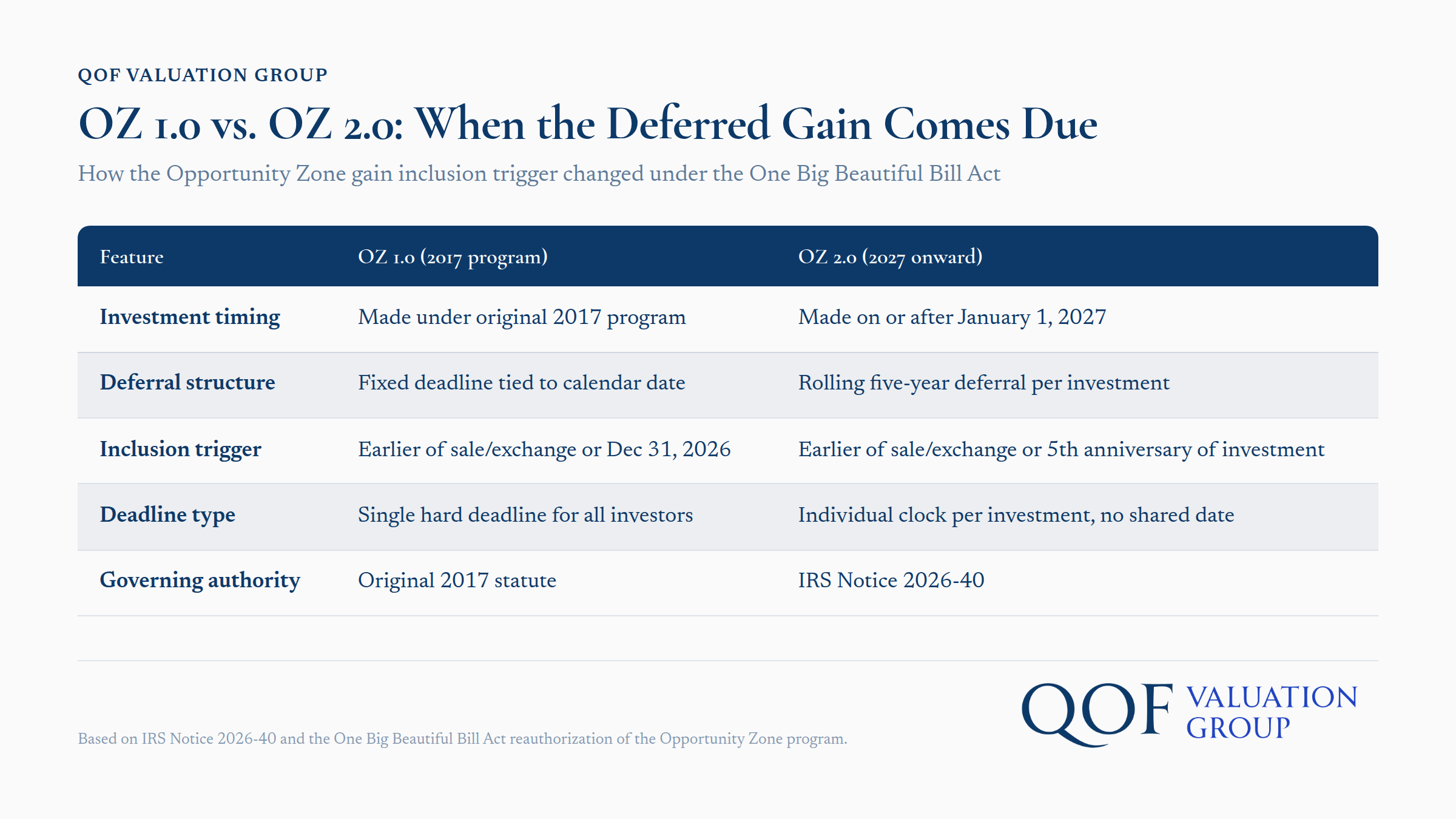
The timing of the deferred gain inclusion event depends on when the investment was made, and this is where the program changed significantly.
For investments made under the original 2017 program (commonly called OZ 1.0), the deferred gain is included in income on the earlier of two triggers: the date the investor sells or exchanges the QOF interest, or December 31, 2026, whichever comes first. That fixed 2026 date was a hard deadline built into the original statute, and it applies regardless of how long the investor intends to hold the QOF interest.
The One Big Beautiful Bill Act reauthorized the Opportunity Zone program on a permanent, ongoing basis, and for investments made on or after January 1, 2027 (OZ 2.0), the fixed 2026 deadline no longer applies. Instead, these newer investments operate on a rolling five-year deferral: the deferred gain is included on the earlier of a sale or exchange of the QOF interest, or the fifth anniversary of the date the investment was made, per guidance issued in IRS Notice 2026-40. Every OZ 2.0 investment carries its own five-year clock rather than converging on a single calendar date. Our explainer on what happens to opportunity zones after 2026 and what OZ 2.0 changes walk through the transition in more detail.
Why the Inclusion Event Requires a Fair Market Value Appraisal
Whichever trigger applies, the inclusion event forces a specific calculation: the taxpayer must recognize the lesser of the originally deferred gain, or the fair market value of the QOF investment at the time of inclusion minus the investor's basis in that investment. This is the statutory "lesser-of" rule, and it is the single most consequential number in the entire QOF lifecycle for an investor whose gain hasn't already been recognized through a sale.
Here's the problem for most investors: QOF and QOZB interests are typically illiquid limited partnership interests with no public market and no readily observable trading price. There is no quoted share price to plug into a tax return. Establishing the fair market value side of the lesser-of comparison requires a defensible valuation of the specific LP interest, one that accounts for the underlying real estate or operating business, applies appropriate minority interest treatment, and reflects discounts for lack of control (DLOC) and lack of marketability (DLOM) where the facts support them.
Key takeaway: The deferred gain inclusion event isn't just a tax filing formality. It's a valuation event, and the number an investor reports directly affects their tax liability at a moment when the IRS has every incentive to scrutinize the math.
This is the exact gap our team at QOF Valuation Group was built to close. We prepare fair market value appraisals of QOF and QOZB interests for the inclusion event, applying USPAP-compliant methodology, with credentialed appraisers holding designations recognized by the American Society of Appraisers and the National Association of Certified Valuators and Analysts, consistent with standards maintained by The Appraisal Foundation. If you want the mechanics of the lesser-of rule and how the appraisal interacts with your basis calculation, our companion piece on the QOF lesser-of rule and why your gain inclusion needs a real appraisal goes deeper on that specific requirement.
Getting Ready for Your Inclusion Event
Whether your deferred gain comes due at the end of 2026 under the original program or on a rolling five-year schedule under the newer rules, the fair market value appraisal isn't optional once the inclusion event arrives. Our team at QOF Valuation Group prepares USPAP-compliant valuations of QOF and QOZB interests built specifically for this moment. Request an appraisal to get ahead of your inclusion date before the clock runs out.
This article is provided for general informational purposes only and does not constitute legal, tax, or financial advice. Readers should consult a qualified attorney or CPA regarding their specific circumstances.