
Blog
IRS Form 8997: How to Report Your Qualified Opportunity Fund Investment Each Year
Every taxpayer holding a Qualified Opportunity Fund investment must file IRS Form 8997 with their federal return each year, and the OBBBA's 2027 rule changes make accurate reporting more consequential than ever. This guide walks through the form's four parts, the basis step-up rules under the old and new regimes, and where a defensible fair market value substantiates what you report.
If you hold an interest in a Qualified Opportunity Fund (QOF), the IRS wants to know about it every single year, not just the year you invested. IRS Form 8997 is the annual tracking statement that keeps your deferred gain, your basis, and your fund holdings in sync with the rest of your tax return. With the One Big Beautiful Bill Act (OBBBA) rewriting the rules for investments made on or after January 1, 2027, understanding exactly what this form requires, and where a defensible valuation fits into it, matters more than it did a year ago.
What Is IRS Form 8997 and Who Has to File It?
Form 8997, the Initial and Annual Statement of Qualified Opportunity Fund (QOF) Investments, must be attached to a timely filed federal income tax return, including extensions, by any eligible taxpayer who held a QOF investment at any point during the year, according to the IRS's Form 8997 overview. This isn't a one-time filing tied to your initial investment. It's an annual obligation that continues for as long as you hold the interest.
Eligible filers include individuals, C corporations (including RICs and REITs), partnerships, S corporations, trusts, and estates. If any of these entities holds a QOF interest on December 31 of a given tax year, or disposed of one during the year, Form 8997 needs to be part of that year's return.
Watch out: Missing a year of Form 8997 filing doesn't just create a compliance gap. It breaks the paper trail the IRS uses to verify your deferred gain balance, which can create problems years later when an inclusion event or a basis step-up election finally triggers recognition.
The Four Parts of Form 8997
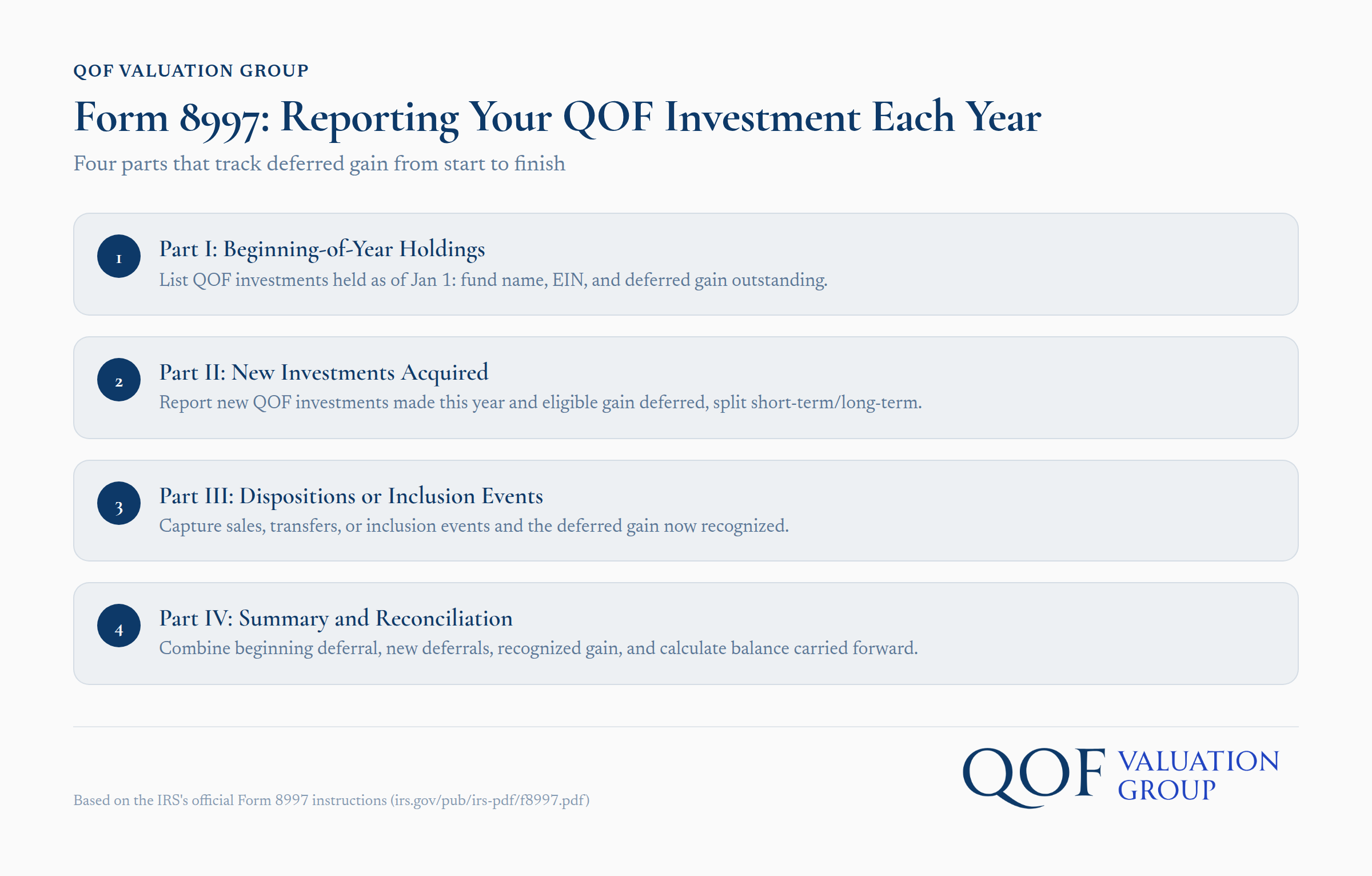
Form 8997 is organized into four parts, and each one answers a different question about your QOF position for the year, per the IRS's official form instructions.
- Part I: QOF Investments Held at the Beginning of the Year
- Lists every QOF investment you already held as of January 1, including the fund's name, EIN, and the deferred gain still outstanding.
- Part II: QOF Investments Acquired During the Year
- Reports any new QOF investments made during the tax year and the amount of eligible gain deferred through each one, broken out as short-term or long-term.
- Part III: QOF Investments Disposed of or Subject to an Inclusion Event
- Captures any sales, transfers, or other inclusion events during the year, along with the amount of previously deferred gain that becomes recognized as a result.
- Part IV: Summary and Reconciliation
- Ties everything together: beginning deferred gain, new deferrals from Part II, gain recognized in Part III, and the deferred gain balance carried into next year.
Each QOF listed requires specific detail: the fund's name and EIN, the acquisition date, the disposition or inclusion date if applicable, the amount of eligible gain deferred, and any basis adjustments that apply. Getting these figures wrong in one year cascades into every subsequent filing, since Part I of each new year's form should mirror Part IV of the prior year's.
How Form 8997 Ties to Form 8949 and Schedule D
Form 8997 doesn't work in isolation. The initial deferral election happens on Form 8949 in the year the underlying capital gain (or qualified Section 1231 gain) would otherwise be recognized, and that gain must generally be reinvested into a QOF within 180 days of the sale that generated it, according to IRS guidance on investing in a Qualified Opportunity Fund.
Once that election is made, Form 8997 becomes the ongoing ledger. If you already filed a return without making the deferral election, the IRS allows the election to be made later through an amended return or an Administrative Adjustment Request, with Form 8949 completed accordingly. Any gain recognized in a later year because of an inclusion event flows back onto Form 8949 and Schedule D for that year, which is why the two forms have to stay reconciled.
Pro tip: Keep a running reconciliation worksheet outside your tax software that mirrors Form 8997 Part IV. When an inclusion event or a basis step-up election happens, you'll want your own record of exactly how the deferred gain balance was built, not just what the software carried forward.
When Deferred Gain Becomes Taxable: The Inclusion Event Rule
For QOF investments made before January 1, 2027, deferred gain is recognized on the earlier of an inclusion event (generally a sale or other disposition of the QOF interest) or December 31, 2026. The reportable amount is calculated as the lesser of the original deferred gain or the fair market value of the QOF interest at the time of inclusion, minus the investor's adjusted basis, per IRS guidance on Qualified Opportunity Fund investments.
Example: An investor deferred $400,000 of gain into a QOF in 2021. By the time an inclusion event occurs, the fund interest's fair market value has grown to $520,000, but the investor's basis is still $40,000 (before any step-up). Because $400,000 (the original deferred gain) is less than $520,000 (current FMV), the reportable recognized gain is $400,000 minus $40,000 of basis, or $360,000, adjusted for whatever basis step-up applies at that point.
That lesser-of comparison is exactly where a substantiated valuation becomes necessary. Our QOF lesser-of rule guide walks through this calculation in more depth, including how the fair market value component gets established when there's no public market for the interest.
The OBBBA Made Opportunity Zones Permanent, But Changed the Rules for New Investments
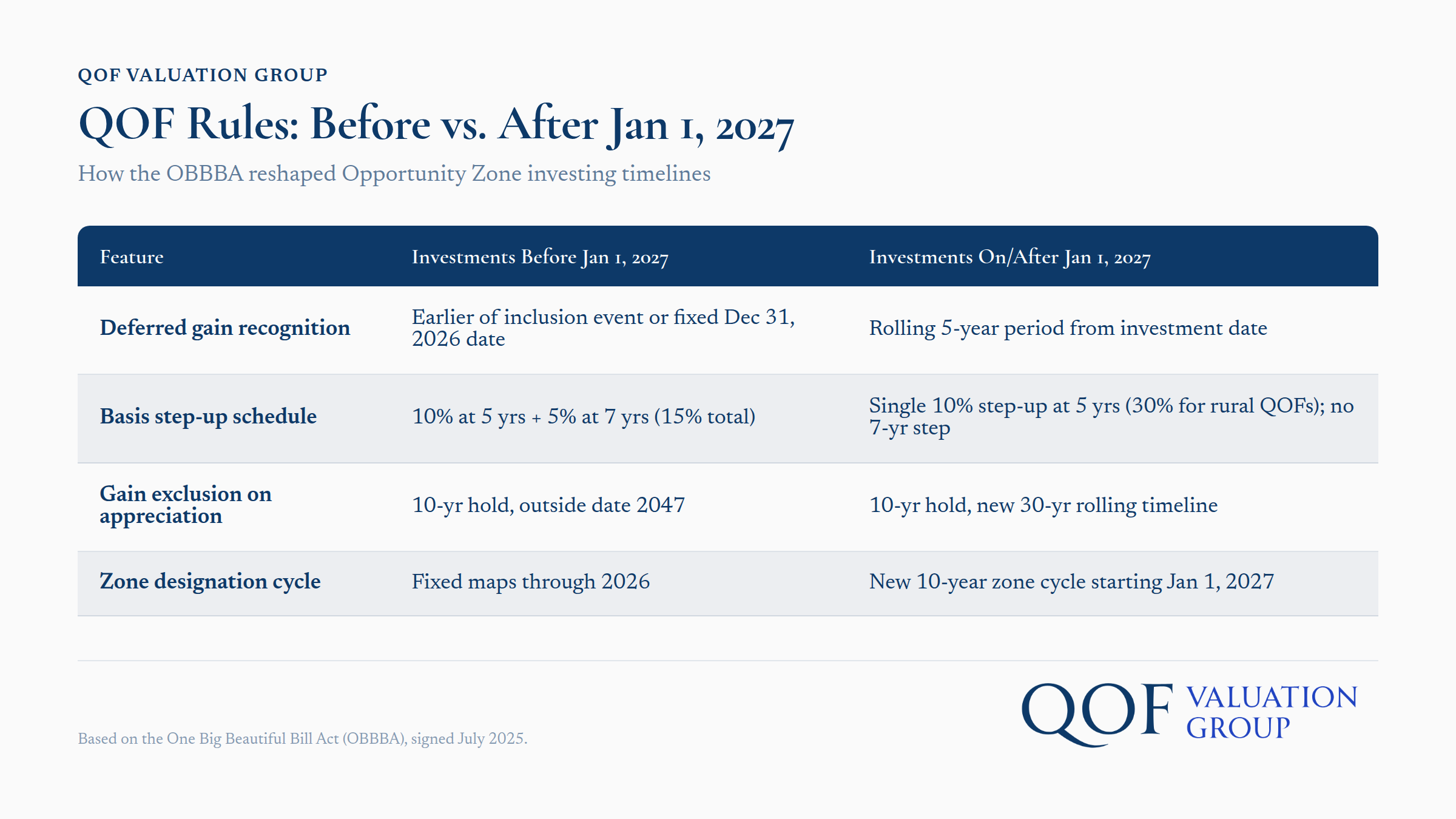
The One Big Beautiful Bill Act, signed in July 2025, eliminated the sunset that would have ended new Opportunity Zone investments after December 31, 2026. The program is now permanent, but it runs on two different rulebooks depending on when you invested.
| Feature | Investments Before Jan 1, 2027 | Investments On or After Jan 1, 2027 |
|---|---|---|
| Deferred gain recognition | Earlier of inclusion event or Dec 31, 2026 (fixed date) | Rolling 5-year period from investment date |
| Basis step-up schedule | 10% after 5-year hold; additional 5% after 7-year hold (15% total) | Single 10% step-up at 5-year mark (30% for Qualified Rural Opportunity Funds); no 7-year step |
| Gain exclusion on appreciation | 10-year hold, outside date of 2047 | 10-year hold retained, on a new 30-year rolling timeline |
| Basis freeze on long-held interests | Not applicable under old regime | Basis frozen at FMV on the 30th anniversary |
| Zone designations | Fixed maps through 2026 | New 10-year zone cycle starting Jan 1, 2027 |
New Opportunity Zone designations now follow a 10-year cycle. The current zone maps sunset at the end of 2026, and a new set of zones takes effect January 1, 2027, with governors expected to designate the updated zones by roughly mid-2026.
Why the January 1, 2027 Investment Date Is the Critical Planning Line
The single most important date in the post-OBBBA landscape is the investment date, not the current calendar year. Investments made before January 1, 2027 stay under the old rules for their entire life: fixed 2026 recognition, the 10%/7% step-up schedule, and the 2047 outside exclusion date. Investments made on or after January 1, 2027 fall entirely under the new rolling regime, with its 5-year deferral window and 30-year basis freeze.
This matters for anyone still weighing a new QOF investment. An investor who closes a deal in December 2026 locks in one set of rules; the same investor closing in January 2027 locks in a completely different one. For more on how the timeline plays out, our FAQ on what happens to Opportunity Zones after 2026 and our FAQ on the 10-year rule for QOZ investments break down each scenario in isolation.
Why Fair Market Value Drives What You Report on Form 8997
Three distinct moments in a QOF investment's life require a defensible fair market value, and Form 8997 (or the Form 8949 entries feeding it) is where each one gets reported.
- Inclusion events: Recognized gain equals the lesser of the deferred gain or the FMV of the QOF interest, minus basis. Without a substantiated FMV, there's no way to make that comparison correctly.
- The 10-year basis step-up election: Investors who hold a QOF interest for 10 years can elect to step up basis to the interest's fair market value at that time, excluding any gain attributable to the original deferred amount.
- The 30-year basis freeze (new regime): Under the OBBBA's rolling framework, basis is frozen at fair market value on the 30th anniversary of a post-2026 investment, locking in the exclusion of appreciation from that point forward.
In each case, the number that lands on the tax form is only as reliable as the valuation behind it. A QOF interest rarely trades on an open market, and the underlying fund assets (often real estate or an operating business) require the same rigor as any closely held interest valuation.
How QOF Valuation Group Supports Form 8997 Reporting
We are not a tax preparation firm and we don't file Form 8997 on anyone's behalf. What we do is prepare independent, defensible valuations of QOF interests and the underlying real estate or business assets held inside the fund, the kind of substantiation a CPA needs before signing off on the FMV figures that feed an inclusion event, a 10-year step-up election, or a 30-year basis freeze.
Our valuation work is prepared in accordance with USPAP (Uniform Standards of Professional Appraisal Practice) as published by The Appraisal Foundation, and our team holds credentials from organizations including the American Society of Appraisers and NACVA. We build the valuation; your CPA or attorney uses it to complete the reporting. If you're preparing for an upcoming inclusion event or a step-up election and need a fair market value your accountant can rely on, you can request an appraisal directly from our team.
Frequently Asked Questions
Q: Do I have to file Form 8997 if I haven't sold my QOF interest yet? Yes. Form 8997 is filed every year you hold a qualifying investment, not only in the year you invest or the year you dispose of it. As long as you held the interest at any point during the tax year, it belongs in that year's filing.
Q: What happens if I never made the initial deferral election on Form 8949? According to IRS guidance, the election can generally still be made by filing an amended return or an Administrative Adjustment Request, completing Form 8949 for the year the gain would otherwise have been recognized.
Q: Does the OBBBA change the rules for a QOF investment I already made? No. Investments made before January 1, 2027 stay under the original rules for their full life, including the fixed December 31, 2026 recognition date and the 10%/7% basis step-up schedule. The new rolling 5-year and 30-year rules apply only to investments made on or after January 1, 2027.
Q: Who determines the fair market value used in the lesser-of calculation? The taxpayer and their advisors are responsible for substantiating the figure, typically with an independent valuation of the QOF interest or the underlying fund assets. Our lesser-of rule guide covers how that valuation interacts with the recognized gain calculation in more detail.
Keeping Your QOF Reporting Defensible Year After Year
Form 8997 looks like a simple tracking form, but it's the thread that connects every year of a QOF investment's life, from the initial deferral to the final basis freeze decades later. The OBBBA's permanent extension of the program is good news for long-term investors, but it also means two sets of rules now coexist depending on when the money went in. Getting the fair market value right at each inclusion event or step-up election isn't optional paperwork; it's the number your entire tax position rests on. If you're approaching one of those milestones, our team can prepare the independent valuation your CPA needs before the filing deadline arrives.
This article is provided for general informational purposes only and does not constitute legal, tax, or financial advice. Readers should consult a qualified attorney or CPA regarding their specific circumstances.