
Blog
What Is IRS Form 8996? A Guide to QOF Self-Certification and the 90% Asset Test
IRS Form 8996 is how a Qualified Opportunity Fund self-certifies its status and reports the 90% asset test each year, but it says nothing about what an investor's QOF interest is actually worth. This guide breaks down the form's mechanics and explains why investors still need a separate valuation before the December 31, 2026 inclusion event.
IRS Form 8996 is the document that turns a corporation or partnership into a Qualified Opportunity Fund (QOF) in the eyes of the IRS, and it is also the annual report card that measures whether the fund is still holding enough qualifying property to keep that status. If you have invested capital gains into a QOF, understanding this form matters, but understanding what it does not cover matters just as much, especially with the December 31, 2026 deferred gain inclusion event approaching. This guide walks through the self-certification process, the 90% asset test, the penalty for falling short, and why Form 8996 is a fund-level document that leaves your own investor-level valuation question entirely unanswered.
What Is IRS Form 8996?
Form 8996 is the form a corporation or partnership files to certify itself as a Qualified Opportunity Fund and to annually report whether it met the 90% Qualified Opportunity Zone (QOZ) asset requirement during its tax year. According to the IRS's Form 8996 page, the form serves two functions: certifying QOF status in the fund's first qualifying year, and reporting compliance with the investment standard every year after that.
The form also calculates any penalty owed if the fund fails the 90% test. It is filed by the fund entity itself, attached to its federal income tax return (Form 1065 for partnerships or Form 1120 for corporations), never by the individual investors who hold interests in the fund.
Key takeaway: Form 8996 is a fund-level compliance document. It tells the IRS whether the QOF is doing its job, not what any single investor's stake in that fund is worth.
How Does a Fund Self-Certify as a QOF?
A fund becomes a QOF by filing Form 8996 with its own tax return; there is no separate IRS application or approval process. The IRS's guidance on certifying and maintaining a QOF confirms that eligible entities self-certify simply by filing the form for the tax year in which they want QOF treatment to begin.
In Part I of the form, the entity confirms several basic facts:
- The entity is organized as a corporation or partnership (including a multi-member LLC taxed as one of those) under the laws of a state, the District of Columbia, a U.S. possession, or a federally recognized tribal government.
- The entity is organized for the purpose of investing in QOZ property.
- The entity elects the first month of the tax year in which it will be treated as a QOF, which sets the clock for its first asset test.
Once filed, self-certification is not a one-time event. The fund must file Form 8996 every year it wants to keep QOF status, and it must do so by the due date of its return, including extensions.
Watch out: Qualified Opportunity Zone Businesses (QOZBs), the operating companies a QOF invests into, do not file Form 8996. Only the fund entity itself does.
What Is the 90% Asset Test?
The 90% asset test requires a QOF to hold at least 90% of its assets in qualifying QOZ property, averaged across two testing dates each year. Under the statutory framework governing QOFs, the fund measures its percentage of QOZ property on the last day of the first six-month period of its tax year and again on the last day of the tax year, then averages the two results.
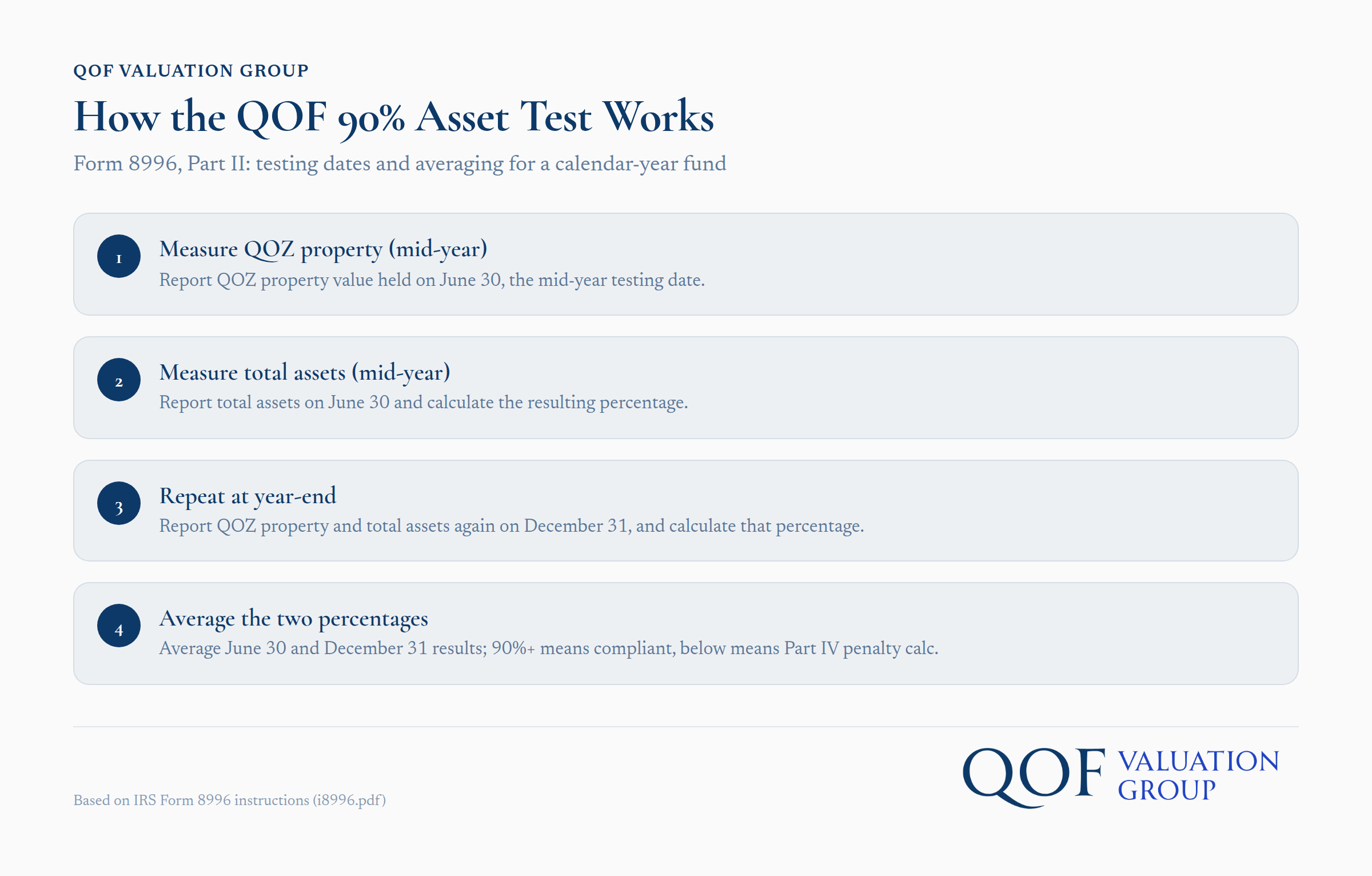
For a calendar-year fund, that means testing on June 30 and again on December 31. Part II of Form 8996 walks through this calculation:
- Report QOZ property value held on the mid-year testing date.
- Report total assets held on that same date, and calculate the percentage.
- Repeat both steps for the year-end testing date.
- Average the two percentages to arrive at the fund's compliance figure for the year.
If that average comes in at 90% or above, the fund is compliant for the year. If it falls short, even by a small margin, the fund moves to Part IV of the form to calculate a penalty.
What Happens If a QOF Fails the 90% Asset Test?
A QOF that fails the 90% asset test owes a monthly penalty equal to the shortfall amount multiplied by the federal underpayment rate, divided by 12, unless it can show reasonable cause. This penalty structure comes from the statute governing Qualified Opportunity Funds and is calculated directly on Form 8996's Part IV, per the form's instructions.
Example: Say a QOF's average QOZ property percentage for the year comes in at 82% instead of the required 90%, an 8-point shortfall. If the fund's aggregate asset value is $10 million, the shortfall amount is $800,000. At a hypothetical 8% federal underpayment rate, the monthly penalty works out to roughly $5,333 (800,000 x 0.08 / 12), assessed for each month the fund remains below the threshold.
The statute also allows a reasonable cause exception: a fund that can demonstrate the failure was not due to negligence or willful neglect, and that it took steps to correct the shortfall, may avoid the penalty even after coming in under 90%. The IRS has addressed technical questions around QOF compliance in guidance such as this IRS Chief Counsel memorandum, which illustrates how closely the agency scrutinizes the mechanics of the 90% test in practice.
Pro tip: The instructions to Form 8996 were updated to reflect Notice 2025-50, layered onto the December 2024 revision. If your fund's administrator is working from an older version of the instructions, confirm the penalty computation section still matches current guidance before the return is filed.
Form 8996 Tells You About the Fund. It Does Not Tell You What Your Interest Is Worth.
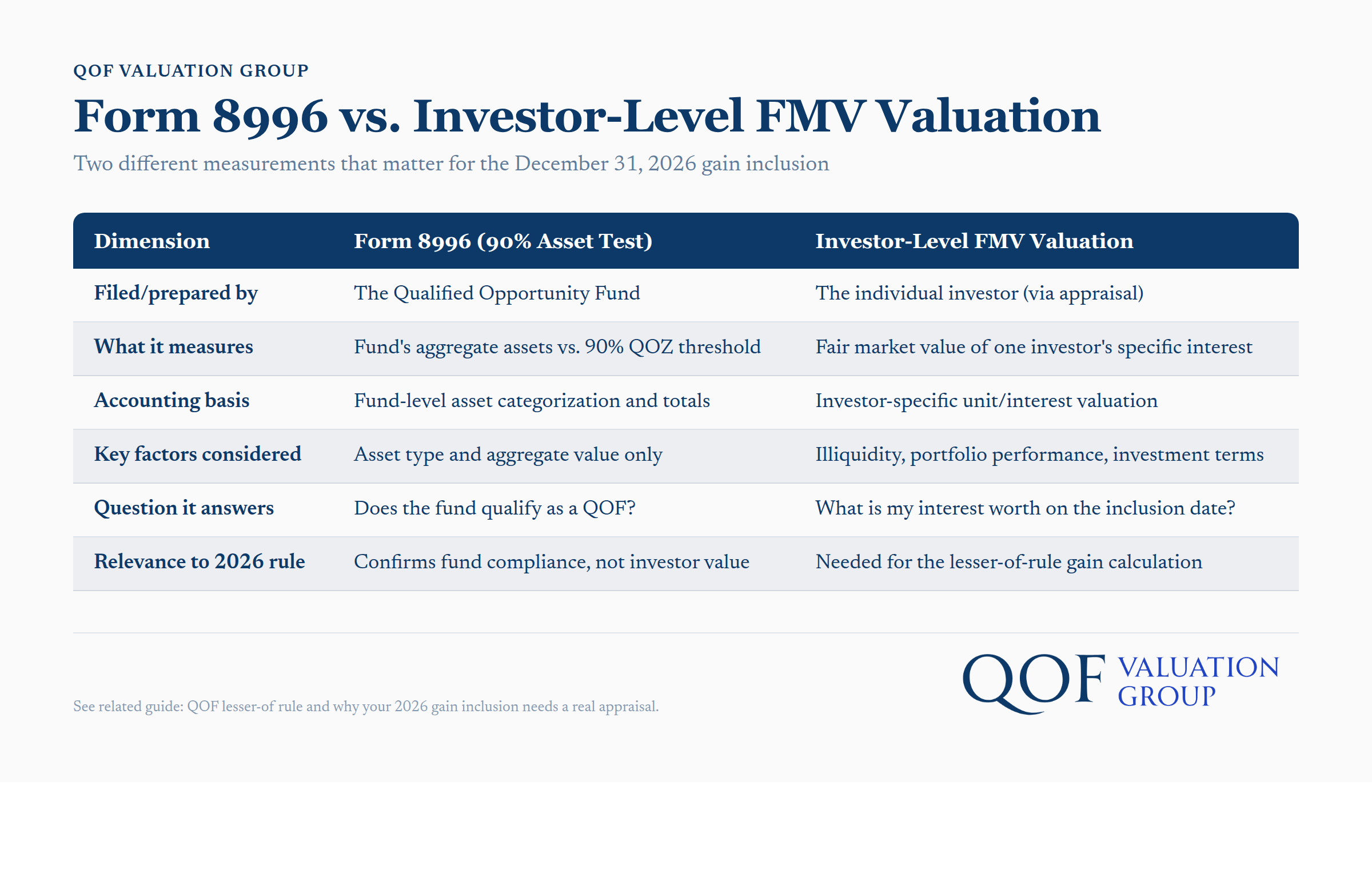
Form 8996 measures the fund's assets against a 90% threshold using fund-level accounting figures. It says nothing about the fair market value of any individual investor's interest in that fund, which is a completely separate question governed by different rules.
This distinction becomes critical as December 31, 2026 approaches. Under the deferred gain inclusion rules, investors who deferred capital gains into a QOF must recognize that gain on their 2026 tax return under a lesser-of rule: the lesser of the originally deferred gain amount, or the fair market value of the QOF interest on the inclusion date. Our earlier guide on the QOF lesser-of rule and why your 2026 gain inclusion needs a real appraisal covers this mechanic in depth.
Here is the practical problem: nothing on Form 8996 produces that fair market value figure. The 90% test uses asset categorization and aggregate value at the fund level. It does not calculate what your specific membership interest or partnership unit is worth on the open market, accounting for illiquidity, the fund's actual portfolio performance, and the terms of your specific investment.
Why Investors Still Need an Independent Valuation Before December 31, 2026
Investors need a defensible, investor-level fair market value valuation of their QOF interest because Form 8996 only certifies the fund, it never values what any single investor owns. The lesser-of rule under the deferred gain inclusion mechanics means your reported gain in 2026 could be substantially lower than your original deferral, but only if you can support the FMV figure you use with a credible, well-documented valuation.
A business valuation prepared for this purpose typically applies recognized methodology, drawing on the same valuation approaches recognized by organizations like the American Society of Appraisers and the National Association of Certified Valuators and Analysts, and prepared in accordance with the Uniform Standards of Professional Appraisal Practice published by The Appraisal Foundation. That standard matters because a valuation used to support a tax position needs to hold up if it is ever reviewed.
Investors should also keep Form 8996 filings on their radar for a different reason: if a fund has a history of failing its 90% test or shows compliance gaps, that can raise questions about whether the underlying interest still qualifies for the treatment investors are counting on. Reviewing a fund's Form 8996 history alongside your own interest's valuation gives a fuller picture heading into the 2026 inclusion year.
Get Ahead of the December 31, 2026 Inclusion Date
Form 8996 keeps the fund compliant. It does not answer the question that matters most to you as an investor: what is your QOF interest actually worth on the date your deferred gain comes due? Our Qualified Opportunity Fund valuation services are built specifically to answer that question, with a defensible, standards-based valuation of your interest ahead of the 2026 deadline. If you hold a QOF investment and need a valuation to support your lesser-of rule calculation, request an appraisal from our team before the inclusion date arrives.
This article is provided for general informational purposes only and does not constitute legal, tax, or financial advice. Readers should consult a qualified attorney or CPA regarding their specific circumstances.