
Blog
Does the IRS Require a Formal Appraisal for Your 2026 QOF Inclusion Event?
No statute or regulation forces a Qualified Opportunity Fund investor to buy a formal appraisal for the December 31, 2026 inclusion event, but the fair market value you report still has to survive an audit. This guide explains what the law actually requires and why documented valuation work beats a broker letter or a sponsor's NAV mark.
Investors holding a Qualified Opportunity Fund investment through the December 31, 2026 mandatory inclusion event are asking a fair question: does the IRS actually require a formal appraisal before that gain gets reported? The short answer is no. Neither IRC Section 1400Z-2(b)-1) nor the IRS Opportunity Zones FAQ names a specific appraiser, appraisal report, or valuation method as mandatory for every investor. What the law requires is a fair market value determination that you can defend if the IRS asks questions later.
That distinction matters more than it sounds. A statutory silence on appraisal requirements is not the same as a free pass to plug in whatever number lowers your tax bill. Our team prepares QOF interest valuations for investors working through exactly this inclusion event, and the pattern we see is consistent: taxpayers who skip documented valuation work are the ones who struggle when the IRS pushes back on a reduced fair market value.
What the Law Actually Requires
The governing provision is straightforward. On the inclusion date, whether triggered by an earlier disposition or by the December 31, 2026 deadline, the investor must determine the fair market value of the qualifying investment and compare it against the remaining deferred gain and adjusted basis. The recognized gain is the lesser of the two figures, minus basis, a mechanic we cover in more depth in our breakdown of the QOF lesser-of rule.
Neither the statute nor the implementing regulations prescribe how that fair market value must be established. Acceptable evidence can include an arm's-length sale price, a recent capital raise, contemporaneous financing terms, or a valuation analysis built on the fund's underlying assets, liabilities, income, and distributions, according to the IRS Opportunity Zones FAQ. What actually creates the obligation to document your number is the general recordkeeping requirement under IRC Section 6001, which requires taxpayers to substantiate the figures on their return. The FMV requirement is a substantiation and recordkeeping obligation, not an appraisal mandate.
Key takeaway: there is no dollar threshold or statutory trigger at which an appraisal becomes legally required for a 2026 inclusion event. The requirement is that whatever value you report, you can prove it if examined.
Why Documented Valuation Work Is Still the De Facto Standard
Here is where the theory runs into practice. If your QOF investment is publicly traded or was recently sold at arm's length, a market price does most of the substantiation work for you. But most Qualified Opportunity Fund interests are privately held, illiquid, and structured through a partnership or S corporation. In those cases, tax advisors increasingly recommend a formal valuation analysis to support any FMV that falls below the original deferred gain, according to guidance from Sikich and BDO.
The stakes are asymmetric. If you report the full deferred gain, there is little for the IRS to challenge. If you report a reduced FMV, meaning you are claiming the investment lost value and therefore owe less tax, you have taken an affirmative position that shifts the burden onto you to prove it. That is precisely the scenario where an examiner is most likely to ask for support, and a vague internal estimate will not hold up.
Partnership and S Corp Interests Add Real Complexity
When the QOF investment is held through a partnership or S corporation, the analysis goes well beyond a single FMV number. The regulations generally measure the includible amount by reference to the gain that would result from a hypothetical fully taxable sale of the qualifying investment at fair market value. That means the analysis has to account for:
- Outside basis, adjusted for the investor's share of income, loss, and prior distributions over the holding period.
- IRC Section 752 debt allocations, since a partner's share of partnership liabilities affects both basis and the amount realized in a hypothetical sale.
- Prior distributions, which can reduce basis below zero in ways that materially change the recognized gain calculation.
- Discounts for lack of control and lack of marketability, where appropriate, for a minority interest in a closely held fund. Our guide to valuing a QOF minority interest covers how those discounts are supported.
Recent commentary from Plante Moran makes the same point: for fund interests with this kind of complexity, a simple NAV figure rarely captures what the hypothetical-sale analysis actually requires. This is not a case where a taxpayer can eyeball a number off a capital account statement and call it fair market value.
Documented Valuation vs. Broker Opinion vs. Sponsor NAV Mark
Investors facing the 2026 inclusion event typically have three sources of a number to work with, and they are not interchangeable when an examiner starts asking questions.
A documented independent valuation applies a recognized methodology (income, market, or asset-based approaches, or some combination), states its assumptions explicitly, and is prepared by a party with no financial stake in the outcome. A broker opinion of value is usually a short letter estimating what an asset might sell for, often without a documented methodology or independence from a transaction the broker hopes to originate. A sponsor NAV mark is the fund manager's own periodic valuation of its assets, useful for investor reporting but inherently self-interested when that same number is used to reduce a taxable gain.
| Criterion | Documented Independent Valuation | Broker Opinion of Value | Sponsor NAV Mark |
|---|---|---|---|
| Methodology documented | Yes, income/market/asset approach stated and applied | Rarely, often a single comparable or rule of thumb | Inconsistent, varies by fund and reporting cycle |
| Independence from outcome | Yes, no stake in the reported value | No, broker often stands to gain from a future transaction | No, sponsor has an interest in the fund's reported performance |
| Assumptions disclosed | Yes, discount rates, comparables, and adjustments explained | Usually not disclosed | Rarely disclosed to individual investors |
| Audit defensibility | Built to withstand IRS scrutiny | Weak, easily challenged as unsupported | Weak, seen as an interested-party estimate |
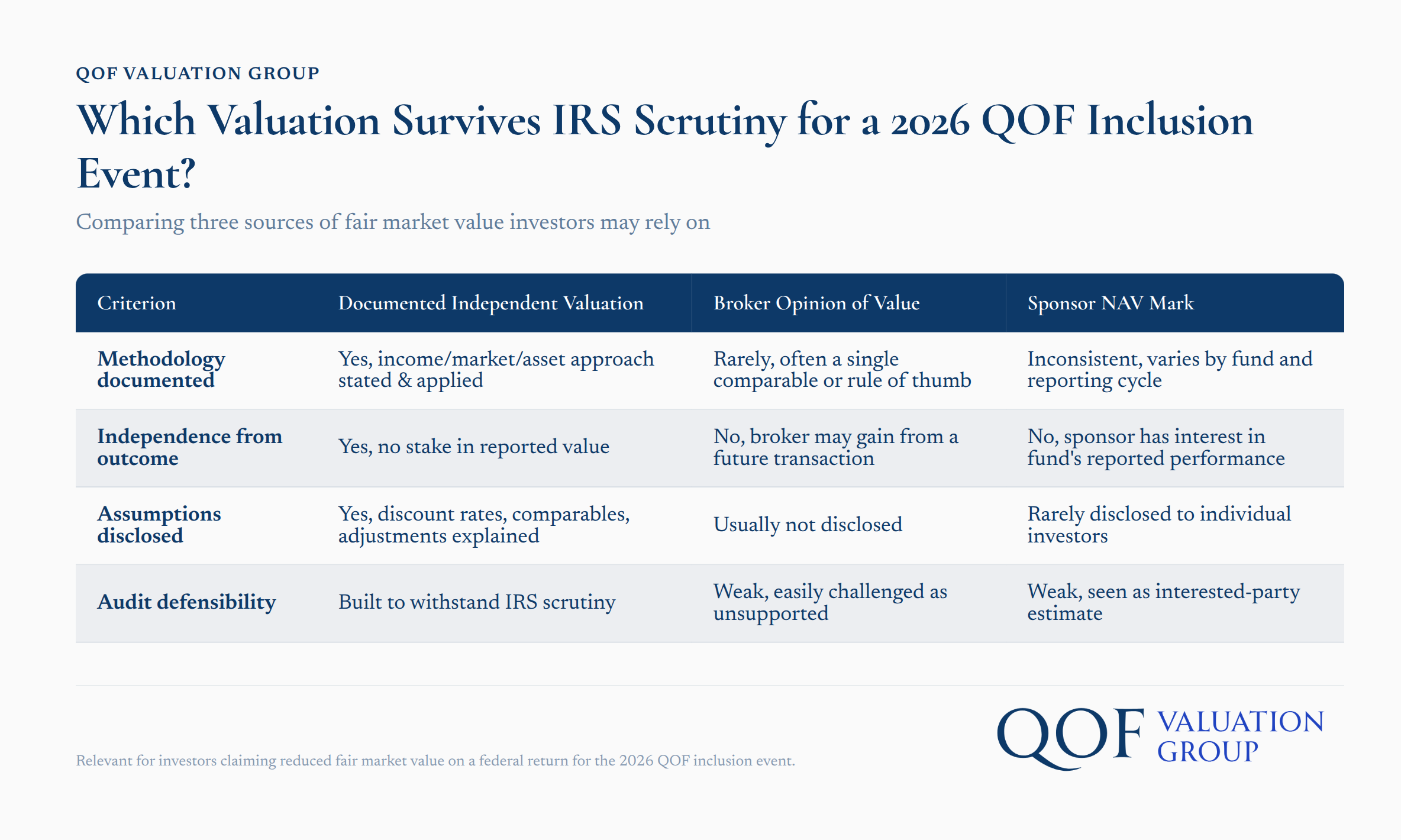
A broker letter or an unsupported NAV mark might be adequate for a lender conversation or a quarterly investor update. Neither is built to survive the kind of scrutiny that comes with claiming a reduced fair market value on a federal return, because neither one documents the assumptions and methodology an examiner would need to see to accept the number.
Timing: Plan Before December 31, 2026, Not After
The inclusion event itself falls on December 31, 2026, but the tax return reporting that gain is not due until April 15, 2027 for calendar-year filers (later if extended). That gap creates a temptation to wait. It is the wrong instinct.
Valuation work for a privately held QOF interest, particularly one held through a partnership with debt allocations and multiple years of distributions to reconcile, takes time to do properly. Waiting until the return is due leaves no room to gather partnership records, reconcile outside basis, or address complications that surface mid-analysis.
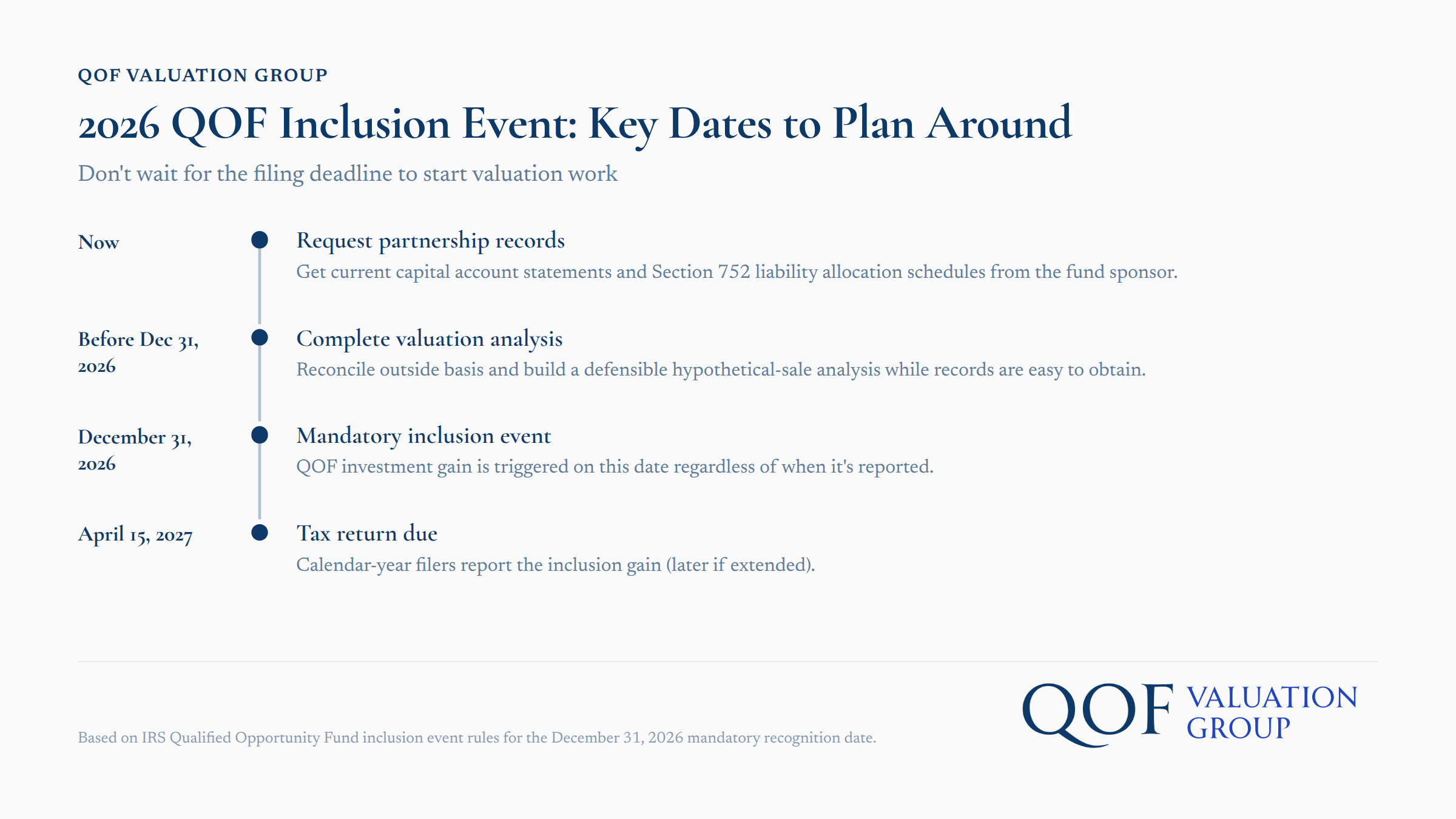
Pro tip: if your QOF investment is held through a partnership or S corporation, request current capital account statements and a schedule of Section 752 liability allocations from the fund now. Those records are the foundation of any defensible hypothetical-sale analysis, and they are far easier to obtain before year-end reporting deadlines create a bottleneck at the sponsor's back office.
What This Means for Your 2026 Filing
Our valuation team treats every QOF interest engagement as a fixed-fee assignment scoped to the entity's complexity, never billed hourly. Work resembling a standard business valuation typically starts at $4,500 for a standard report, with IRS-qualified reporting starting at $5,500 and scaling higher for multi-entity structures, layered debt allocations, or contested valuation positions. The fee reflects the depth of analysis required, not the size of the gain at stake.
The IRS will not tell you in advance whether your number is acceptable, and it will not pre-approve a valuation methodology before you file. What it will do, if your return is examined, is ask you to substantiate the fair market value you reported. A documented, independently prepared valuation is the strongest answer to that question. A broker letter or a sponsor's NAV mark, however convenient in the moment, is a much harder position to defend.
If you are approaching the 2026 inclusion event and need a defensible valuation for a QOF partnership or S corp interest, our team can scope your appraisal well ahead of the April 15, 2027 filing deadline.
This article is provided for general informational purposes only and does not constitute legal, tax, or financial advice. Readers should consult a qualified attorney or CPA regarding their specific circumstances.