
Blog
Valuing a QOF Minority Interest: Applying Discounts for Lack of Control and Marketability
Valuing a Qualified Opportunity Fund interest for tax purposes often requires a discount for lack of control and a separate discount for lack of marketability, and these adjustments are entirely distinct from the entity-level math used for the 90% asset test. This guide shows fund sponsors, CPAs, and investors how DLOC and DLOM apply, in what order, and with what support.
A Qualified Opportunity Fund (QOF) faces two very different valuation questions, and confusing them is one of the more expensive mistakes we see fund sponsors and their CPAs make. One question is entity-level: does the fund hold at least 90% of its assets in qualified opportunity zone property? The other is investor-level: what is a specific investor's minority interest actually worth, for a gift, an estate transfer, a buyout, or a dissolution? Only the second question involves a discount for lack of control (DLOC) and a discount for lack of marketability (DLOM). This guide separates the two and walks through how the discounts are applied when they do belong in the analysis.
The 90% Asset Test Is Not a Fair Market Value Exercise
The 90% asset test does not use DLOC or DLOM at all. It is a compliance measurement, not a fair market value opinion, and it is calculated at the entity level using a specific statutory method.
IRC Section 1400Z-2(d)(1) requires a QOF to hold at least 90% of its assets in qualified opportunity zone property, measured as the average of two testing dates: the last day of the first six-month period of the fund's taxable year, and the last day of the taxable year itself. Treas. Reg. Section 1.1400Z2(d)-1-1) governs how each asset is valued for that test. If the fund has an applicable financial statement (AFS), each asset is valued at the amount reported on that statement. If the fund does not have an AFS, an alternative valuation method applies instead, generally tied to cost basis. The proposed and final regulations under Section 115420-18 lay out this framework in detail. The fund reports the result annually on Form 8996, which serves as the QOF's self-certification and its ongoing 90% asset test disclosure.
None of this involves discounting for a lack of control or a lack of marketability. The test asks what the fund's assets are worth on a controlling, entity-wide basis under a prescribed accounting convention, not what a specific fractional interest would fetch in a hypothetical sale.
Watch out: Do not let a CPA or fund administrator apply DLOC or DLOM figures to the 90% asset test calculation. The test is mechanical and statute-driven. Discounts belong in a separate, investor-level valuation, and mixing the two produces a defective Form 8996 filing and a defective minority interest valuation at the same time.
90% Asset Test vs. Investor-Level Minority Interest Valuation
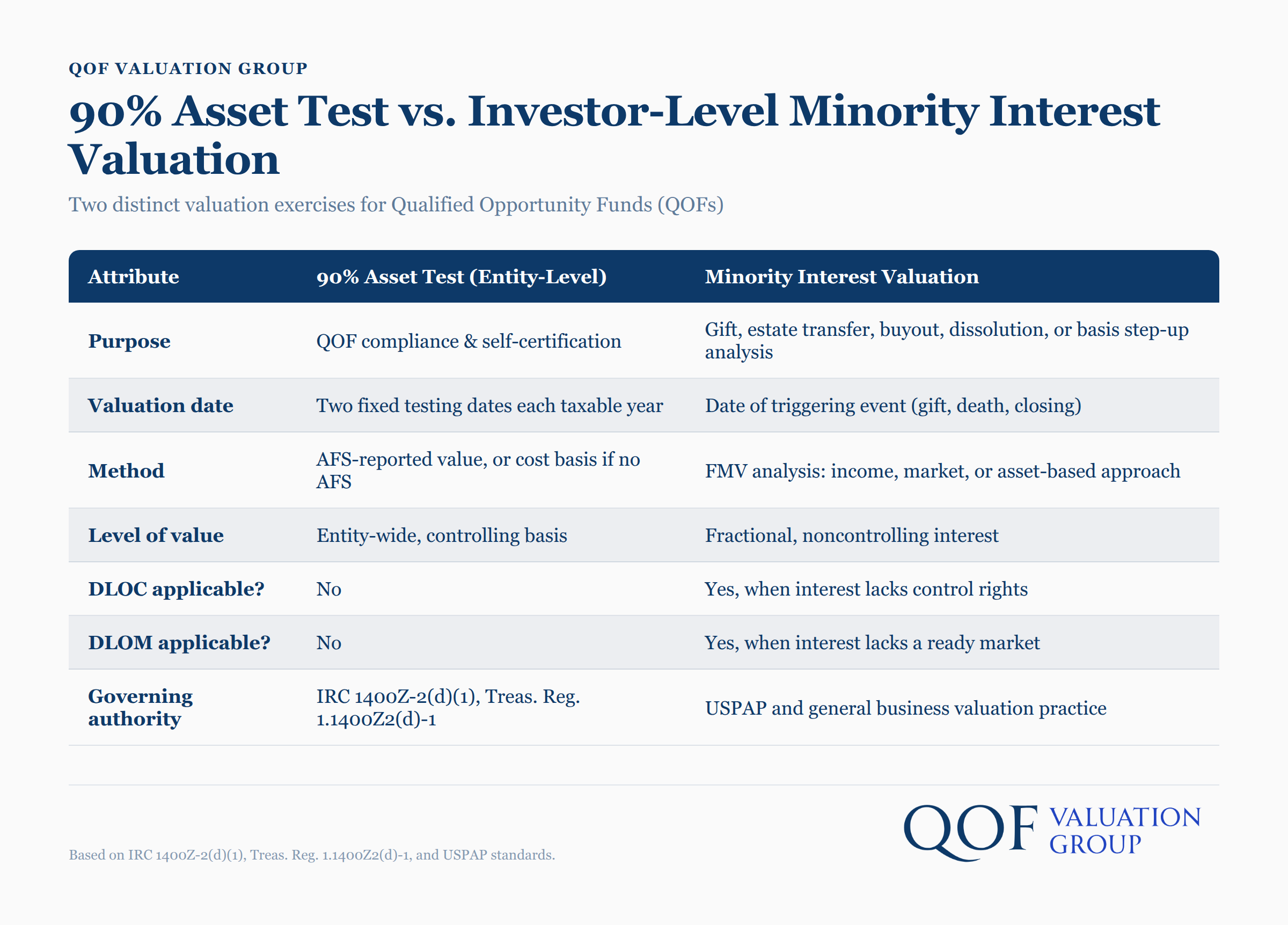
The table below lays out how these two valuation exercises differ in purpose, timing, method, and whether discounts apply.
| Attribute | 90% Asset Test (Entity-Level) | Investor-Level Minority Interest Valuation |
|---|---|---|
| Purpose | QOF compliance and self-certification | Gift, estate transfer, buyout, dissolution, or basis step-up analysis |
| Valuation date | Two fixed testing dates each taxable year | Date of the triggering event (gift date, date of death, closing date) |
| Method | AFS-reported value, or cost basis if no AFS | Fair market value analysis: income, market, or asset-based approach |
| Level of value | Entity-wide, controlling basis | Fractional, noncontrolling interest |
| DLOC applicable? | No | Yes, when the interest lacks control rights |
| DLOM applicable? | No | Yes, when the interest lacks a ready market |
| Governing authority | IRC 1400Z-2(d)(1), Treas. Reg. 1.1400Z2(d)-1-1) | USPAP and general business valuation practice |
What Are DLOC and DLOM?
A discount for lack of control (DLOC), often called a minority discount, reduces value because a noncontrolling owner cannot direct distributions, force a sale, hire or fire management, or set the entity's strategic direction. A discount for lack of marketability (DLOM) reduces value separately because there is no ready market to convert that interest into cash, unlike a share of a publicly traded company that can be sold within days.
These are two distinct concepts, even though they sometimes get blurred together in conversation. A lack of control can contribute to a lack of marketability, since an investor who cannot compel a sale or a distribution also has a harder time finding a buyer. But even a controlling interest in a closely held QOZ business suffers from some degree of illiquidity, because there is no public market and no quick path to cash. The two discounts address different aspects of what an interest is actually worth, and they are quantified separately.
Key takeaway: DLOC is about the absence of control rights. DLOM is about the absence of a ready market. A minority interest in a QOF typically experiences both, and a defensible valuation supports each one on its own facts.
Why Discounts Apply to QOF Minority Interests
Discounts for lack of control and lack of marketability become relevant the moment someone needs the fair market value of a specific investor's fractional interest, rather than the value of the fund or the underlying QOZ business as a whole. Several common QOF scenarios trigger this need:
- Gift or estate transfers. When an investor gifts a QOF interest or it passes through an estate, the transfer is valued at fair market value on the transfer date, and a noncontrolling, illiquid interest is worth less per dollar of underlying asset value than a controlling stake.
- Investor buyouts or redemptions. When a fund or a fellow investor buys out a minority holder outside the fund's normal distribution waterfall, the negotiated or appraised price should reflect the same lack of control and lack of marketability that any outside buyer would demand a discount for.
- Dissolution or restructuring. When a QOF winds down or reorganizes and minority holders' interests must be valued for allocation purposes, the same principles apply.
- Basis step-up analysis under the 10-year holding rule. Investors who hold a QOF interest for at least 10 years can elect to step up their basis to fair market value on disposition, and that fair market value determination is, again, an interest-level exercise subject to DLOC and DLOM where the facts support it.
Pro tip: If your QOF documents include a right of first refusal, a lockup period, or restrictions on transfer, those provisions typically support a larger DLOM, not a smaller one. Build the fund's actual operating agreement language into the valuation record rather than defaulting to an industry average.
How the Discounts Stack: Sequential, Not Additive
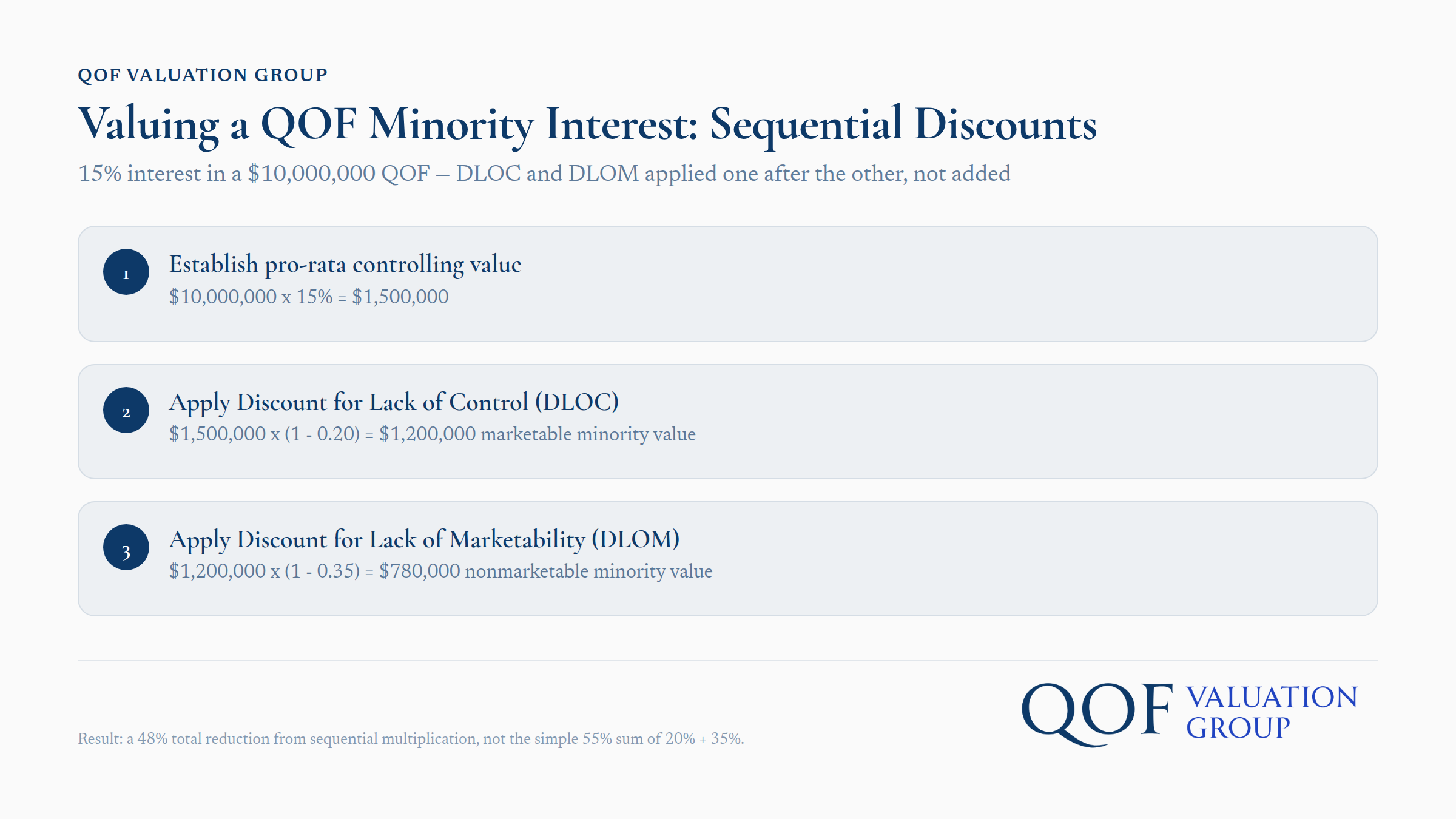
DLOC and DLOM are applied sequentially, one after the other, not added together as a single combined percentage. The calculation starts from the interest's pro-rata share of the entity's controlling value, applies DLOC to arrive at a marketable minority value, and then applies DLOM to that already-discounted figure to arrive at the nonmarketable minority value.
Example: Assume a QOF has an appraised enterprise value of $10,000,000 on a controlling basis, and an investor holds a 15% interest with no control rights and no ready market for resale.
- Establish the pro-rata controlling value. $10,000,000 x 15% = $1,500,000.
- Apply the discount for lack of control. At a supported DLOC of 20%: $1,500,000 x (1 - 0.20) = $1,200,000 marketable minority value.
- Apply the discount for lack of marketability. At a supported DLOM of 35%: $1,200,000 x (1 - 0.35) = $780,000 nonmarketable minority value.
The investor's 15% pro-rata share, worth $1,500,000 on a controlling basis, is valued at $780,000 once both discounts are properly applied. Note that this is a 48% total reduction, even though the two discounts of 20% and 35% do not simply add to 55%. Multiplying sequentially instead of adding is what produces that difference, and it is the standard practice in business valuation.
What Discount Percentages Are Actually Supportable?
There is no fixed percentage for either discount. Every DLOC and DLOM figure must be supported by the specific facts of the interest being valued, not pulled from a rule of thumb.
Empirical studies of restricted stock sales and pre-IPO transactions are the most commonly cited evidence base for DLOM, and discounts for noncontrolling interests in closely held businesses drawn from that research commonly cluster in the 30% to 50% range relative to their freely tradable counterparts. That range is a starting reference point, not a target. A specific QOF interest may justify a discount well above or below it depending on factors like the length of the fund's expected holding period, the presence of any secondary market for the interest, distribution history, and the specific transfer restrictions in the fund's governing documents.
Courts have taken varied positions on acceptable discount levels, and outcomes differ significantly by jurisdiction and by the strength of the evidence presented. Some courts have rejected discounts they viewed as unsupported by the specific facts of the case, even when the analyst's math was internally consistent. This is exactly why a rule-of-thumb percentage is a liability rather than a shortcut. Appraisal practice conducted in accordance with USPAP requires the analyst to tie the specific percentage applied to the specific facts and circumstances of the interest, the fund, and the underlying QOZ business, with documented reasoning that would hold up under review.
Getting the Valuation Right Before the Transfer, Not After
The cost of getting this wrong shows up later, usually during an IRS inquiry, an estate audit, or a dispute between investors over a buyout price. A valuation that conflates the entity-level 90% asset test with an investor's fractional interest, or that applies a discount percentage without facts-and-circumstances support, is a weak foundation for a filing that may be reviewed years after the transfer date.
Our team prepares USPAP-compliant valuations for Qualified Opportunity Fund interests and the underlying QOZ businesses, drawing on credentials including the ASA and NACVA to support gift and estate transfers, investor buyouts, dissolutions, and basis step-up determinations. If you need a defensible valuation for a QOF minority interest, our Qualified Opportunity Fund Valuation Services team can help, or you can request an appraisal directly to get started.
This article is provided for general informational purposes only and does not constitute legal, tax, or financial advice. Readers should consult a qualified attorney or CPA regarding their specific circumstances.