
Blog
QOF Valuation Audit Risk: Six Red Flags That Draw IRS Scrutiny to Your Discounts
These are the six patterns that most often turn a qualified opportunity fund interest's lack-of-control or marketability discount into an IRS examination target. Knowing them before the December 31, 2026 inclusion date lets you build a defensible valuation file instead of an audit invitation.
Investors recognizing deferred gain on a qualified opportunity fund interest ahead of the December 31, 2026 inclusion date often look to a valuation discount to reduce the amount includible. That's a legitimate strategy under the fund's basis mechanics, but it only works if the discount survives scrutiny. Qof valuation audit risk isn't abstract: it shows up in a handful of recurring patterns that examiners and courts have flagged for decades in closely held interest valuations, and QOF interests are no exception.
This article covers the six red flags most likely to trigger a challenge to a QOF discount, drawn from how the IRS and the Tax Court have historically approached lack-of-control and marketability discounts on partnership and LLC interests. For the mechanics of calculating the discount itself, our guide to valuing a QOF minority interest walks through the discount for lack of control and discount for lack of marketability in detail. This post focuses on what makes an examiner stop and ask questions.
Why the Inclusion Date Raises the Stakes
Under the gain inclusion rules, a QOF investor generally recognizes deferred gain based on the lesser of the deferred gain amount or the fair market value of the qualifying investment on the inclusion date, a calculation set out in IRC Section 1400Z-2(b)(2)(A). A lower fair market value on that date can meaningfully reduce the amount includible. That's exactly why a discount applied near the inclusion date draws more attention than one applied in an ordinary year: the dollar impact is concentrated and visible on a single return.
The basis step-up mechanics for investments held long enough to qualify matter for the same reason. Investments held at least 10 years can receive a special fair-market-value basis adjustment on disposition under the related regulation, 26 CFR Section 1.1400Z2(c)-1-1). The IRS has issued guidance addressing inclusion-event timing and reporting obligations as the program matures, including IRS Notice 2026-40. None of this changes the valuation standard itself: fair market value still means what a willing buyer would pay a willing seller, neither under compulsion, with reasonable knowledge of the relevant facts. That remains the baseline against which every discount gets measured.
Red Flag 1: Unsupported or Formulaic Discounts
The single most common trigger is a discount pulled from a prior deal, an industry rule of thumb, or a published survey average, rather than derived from the specific partnership agreement governing the QOF interest. A 30% combined discount that shows up identically across unrelated engagements looks like a template, not an opinion of value.
General commentary on defending business valuations in IRS examinations consistently identifies this as the first thing an examiner checks: does the discount percentage tie back to the actual governance provisions, distribution history, and transfer restrictions in the document, or does it float free of them? Factors that have long informed fair market value determinations for closely held interests, including the nature of the business, its earning and dividend capacity, book value, and prior sales of comparable interests, remain the touchstone (general commentary on business valuation methodology in estate and gift contexts walks through how these factors get applied in a transfer-tax setting).
Watch out: If your appraiser can't point to a specific clause in the operating agreement, a specific distribution history, or a specific transfer restriction that justifies the size of the discount, the number is vulnerable regardless of how reasonable it looks on paper.
Red Flag 2: A Non-Independent Valuer
An appraisal directed by the taxpayer toward a predetermined conclusion reads as advocacy, not an opinion of value, and examiners are trained to spot the difference. Independence isn't just a credentialing question; it's about whether the appraiser reached the number through analysis or was steered toward it.
General guidance on defending a business valuation in an IRS audit points to the same pattern repeatedly: valuations prepared with the client dictating assumptions, selecting comparables after seeing preliminary results, or requesting revisions that move the number in a specific direction are far more likely to be challenged successfully. A report should be prepared under recognized valuation standards by an appraiser working independently of the outcome, with the analysis, not the client, driving the conclusion.
Our appraisers hold credentials with organizations such as the ASA and NACVA and prepare reports consistent with the Uniform Standards of Professional Appraisal Practice. That framework exists precisely to separate an opinion of value from an advocacy document.
Red Flag 3: Missing or Incomplete Documentation
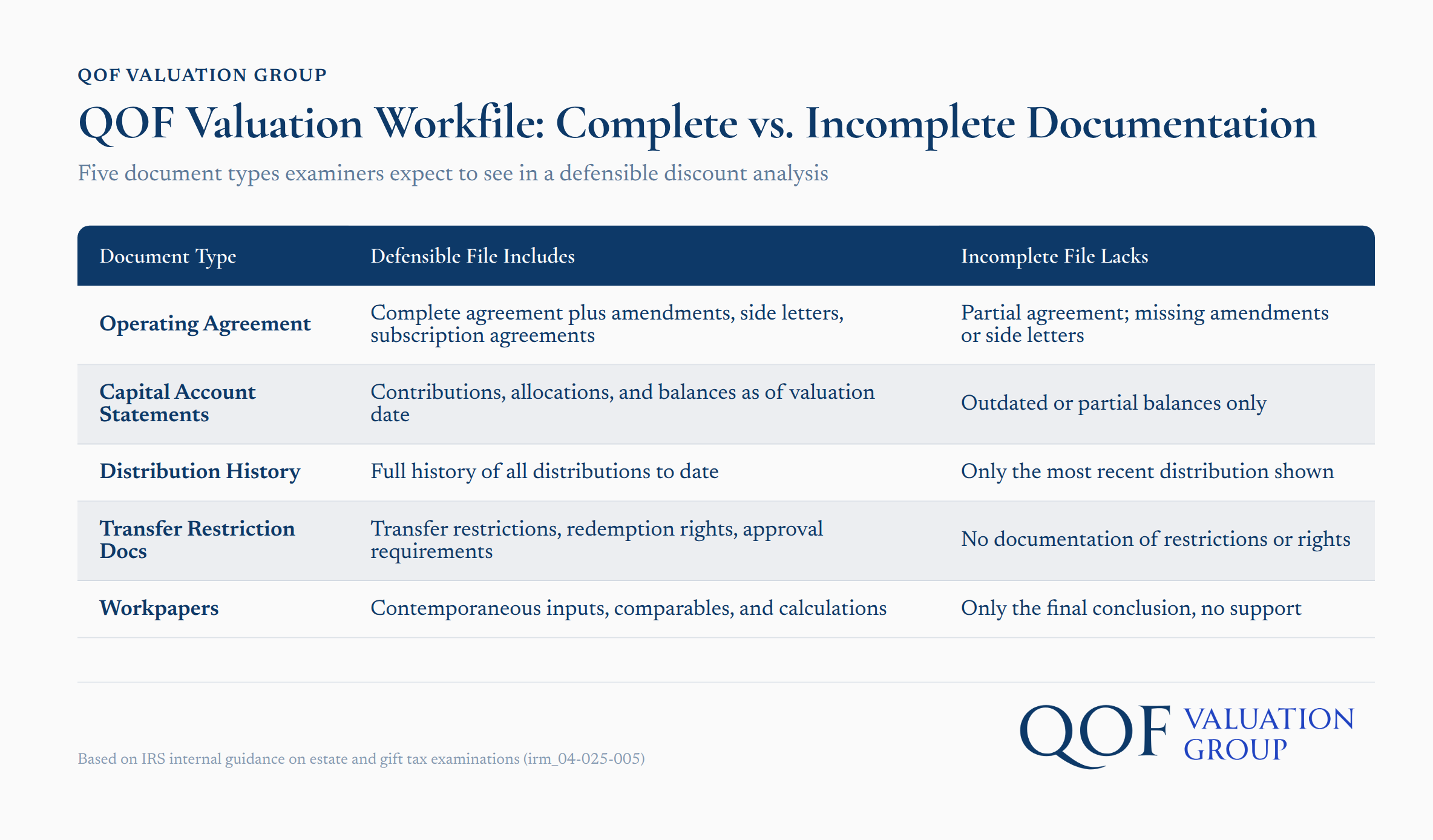
An examiner who can't reconstruct the analysis from the file will assume the worst. A complete workfile should let a reviewer retrace every step from the underlying facts to the final discount percentage.
At minimum, a defensible QOF valuation file should include the following:
- The complete partnership or LLC operating agreement, including any amendments, side letters, and subscription agreements
- Capital account statements showing each partner's contributions, allocations, and balance as of the valuation date
- A full distribution history, not just the most recent distribution
- Documentation of any transfer restrictions, redemption rights, or approval requirements affecting the interest
- Contemporaneous workpapers showing the specific inputs, comparables, and calculations used, not just the final conclusion
General IRS examination guidance for complex valuation issues in transfer-tax matters directs examiners to evaluate the technical basis and supporting documentation behind a reported value, not just the final number (see the IRS's internal guidance on estate and gift tax examinations). A QOF valuation file should be built to withstand that same level of review.
Red Flag 4: Inconsistent or Incorrect Valuation Dates
A discount calculated as of the wrong date is defective even when the methodology behind it is sound. Two mismatches show up most often. The first is valuing the underlying qualified opportunity zone business asset as of one date and the limited partnership interest itself as of a different date, when both should reflect conditions as of the actual inclusion event. The second is relying on market data or financial results that postdate the inclusion date, effectively importing hindsight into a valuation that has to stand on what was knowable on December 31, 2026.
The regulations governing how a QOF values its own assets for the 90% asset test require that the fund apply its chosen valuation method consistently across all assets for the taxable year, as set out in 26 CFR Section 1.1400Z2(d)-1. That consistency principle extends naturally to investor-level valuations: switching dates or methods between the fund's test and the investor's own discount analysis invites exactly the kind of scrutiny the consistency rule was designed to prevent.
Pro tip: Confirm the valuation date on the engagement letter matches the actual inclusion event date before the analysis begins, not after the report is drafted.
Red Flag 5: Double-Counting or Duplicated Discounts
A discount for lack of control and a discount for lack of marketability address different things: one reflects the inability to direct the entity's decisions, the other reflects the difficulty of converting the interest to cash. They should be applied sequentially and distinctly, each with its own quantitative support, not blended into a single combined percentage pulled from a chart.
The risk compounds in tiered partnership structures, where a QOF sits above an operating qualified opportunity zone business. Applying a control discount at the operating-entity level and then applying another control discount again at the fund level, without reconciling how much of the restriction is already reflected in the first discount, effectively double-counts the same economic constraint. The same error occurs when a marketability discount gets applied at both tiers without adjusting for the fact that the upper-tier interest's marketability already reflects the lower tier's characteristics. Tax Court commentary on closely held interests has repeatedly pushed back on exactly this kind of mechanical stacking when it isn't tied to the specific facts at each tier. The minority interest valuation guide on this site walks through how to apply these discounts sequentially rather than as a blended number.
Red Flag 6: Ignoring the Distributions and Debt-Financed Loss Allocation Rule
This is the red flag most likely to waste money on an appraisal before anyone realizes it won't help. A special rule under Treasury Regulation Section 1.1400Z2(b)-1(e)(4)-1) can override a low reported fair market value when the QOF interest has received distributions, or debt-financed loss allocations, in excess of the investor's basis. In that situation, the amount includible on the inclusion date is tied to those distributions and allocations rather than to the discounted fair market value alone.
In plain terms: if your partner or client has already pulled significant distributions out of the fund, or received debt-financed losses beyond their basis, a valuation discount may not reduce the inclusion amount the way the investor expects, no matter how well-supported the discount is. Checking this provision first, before commissioning an independent appraisal, saves the cost of a report that can't deliver the intended tax result.
Key takeaway: A technically flawless discount analysis cannot override a statutory rule that computes the includible amount a different way. Confirm which rule governs before paying for the valuation.
Red Flags vs. Defensible Practices at a Glance
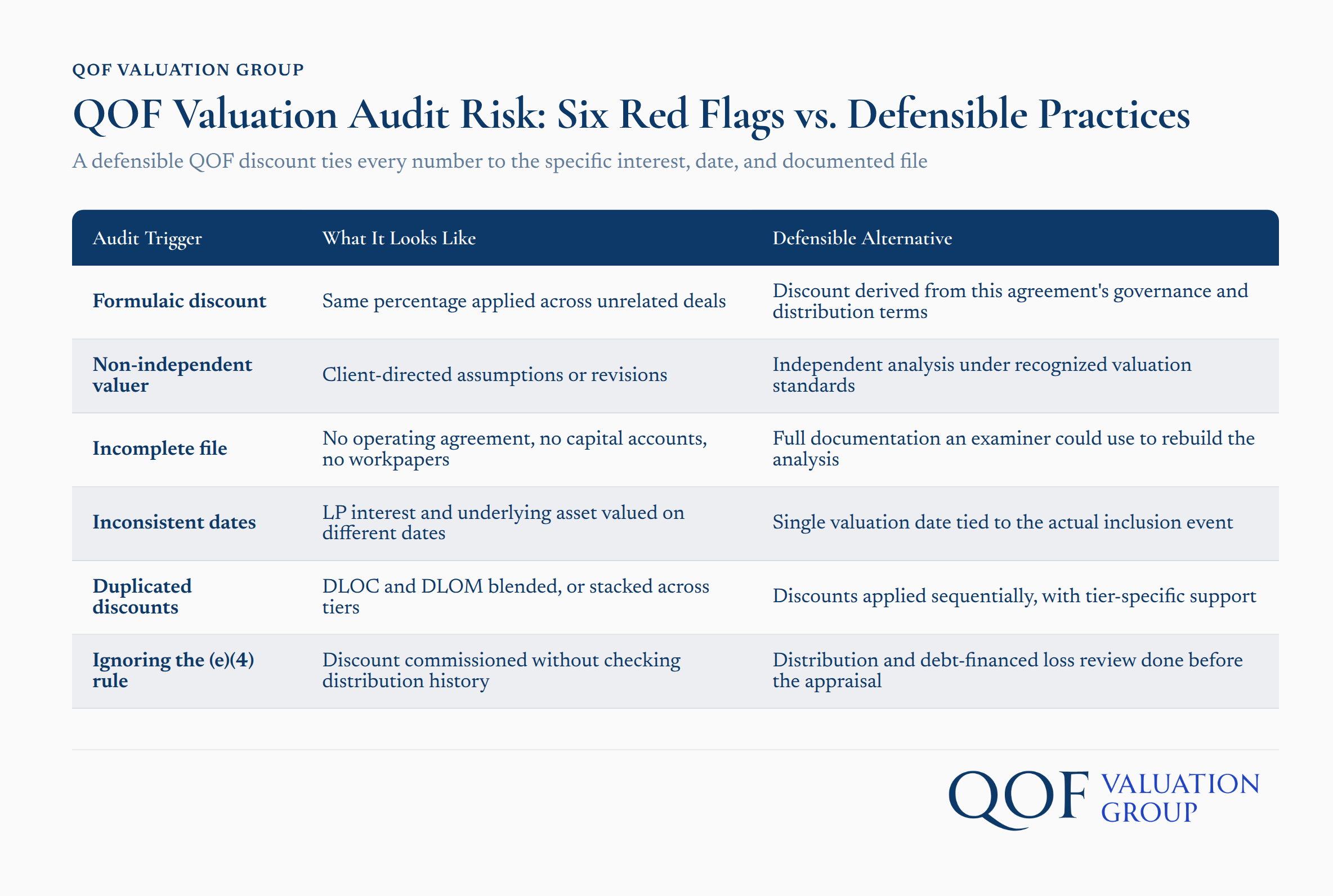
The pattern across all six red flags is the same: a defensible QOF discount ties every number back to the specific facts of the specific interest, on the specific date, documented in a file an examiner could reconstruct independently.
| Audit Trigger | What It Looks Like | Defensible Alternative |
|---|---|---|
| Formulaic discount | Same percentage applied across unrelated deals | Discount derived from this agreement's governance and distribution terms |
| Non-independent valuer | Client-directed assumptions or revisions | Independent analysis under recognized valuation standards |
| Incomplete file | No operating agreement, no capital accounts, no workpapers | Full documentation an examiner could use to rebuild the analysis |
| Inconsistent dates | LP interest and underlying asset valued on different dates | Single valuation date tied to the actual inclusion event |
| Duplicated discounts | DLOC and DLOM blended, or stacked across tiers | Discounts applied sequentially, with tier-specific support |
| Ignoring the (e)(4) rule | Discount commissioned without checking distribution history | Distribution and debt-financed loss review done before the appraisal |
Building a Defensible File Before the Deadline
With the inclusion date approaching, investors and their advisors have a narrow window to get this right. The valuation itself is only part of the file; the documentation behind it is what determines whether the discount holds up. An independent, USPAP-compliant report that ties its conclusions to the specific partnership agreement, a verified distribution history, and a correct valuation date addresses nearly every red flag described above.
Our team prepares QOF interest valuations as fixed-fee engagements, scoped and quoted before work begins rather than billed hourly. Because these reports fall under business valuation methodology, published fees for a business valuation engagement start at $4,500 for standard reporting and $5,500 for an IRS-qualified report, with the final fee set by the complexity of the entity structure and the depth of analysis required, not by the value of the interest itself.
If your clients are facing a 2026 inclusion event and need a discount that can withstand examination, our QOF valuation services are built around independence, documentation, and a valuation date that matches the actual inclusion event, not a shortcut that saves time now and costs more later.
This article is provided for general informational purposes only and does not constitute legal, tax, or financial advice. Readers should consult a qualified attorney or CPA regarding their specific circumstances.