
Blog
QOF Real Estate vs Business Valuation: Why Your Fund's Holdings Need Different Appraisal Methods
A Qualified Opportunity Fund's real estate and its operating business interests get appraised under completely different standards and approaches. This guide breaks down how qof real estate vs business valuation methodology diverges, from USPAP Standards 1-2 versus 9-10 to the enterprise value concept behind every QOZB appraisal.
A Qualified Opportunity Fund rarely holds just one kind of asset. Most funds mix directly owned real estate with equity stakes in operating companies, the Qualified Opportunity Zone Businesses (QOZBs) that occupy or run a business out of that real estate. When it's time to test the fund's asset composition, reconcile a capital account, or support an investor's basis step-up election, those two holdings do not get valued the same way. If you're still getting oriented on what a Qualified Opportunity Fund is and how it works, that background will make the rest of this easier to follow.
This guide walks through why real property and operating business interests sit under different appraisal standards, use different valuation approaches, and ultimately answer different questions.
Two Standards Tracks Govern How a QOF's Assets Get Appraised
Real property and operating business interests are not interchangeable appraisal subjects, and the standards that govern them reflect that. Directly held real estate is appraised under USPAP Standards 1 and 2, the sections of the Uniform Standards of Professional Appraisal Practice that cover real property appraisal and reporting. Operating business interests and QOZB equity fall under a separate track: USPAP Standards 9 and 10, which govern business and intangible asset appraisal.
That distinction is not just procedural. A real property appraisal answers a narrow question: what is this specific parcel, building, or leasehold worth? A business appraisal answers a broader one: what is the entire operating enterprise, tangible assets, working capital, contracts, workforce, and goodwill together, worth as a going concern? Appraisers who work on the business side typically hold credentials from organizations such as the American Society of Appraisers or the National Association of Certified Valuators and Analysts, applying that organization's methodology alongside USPAP.
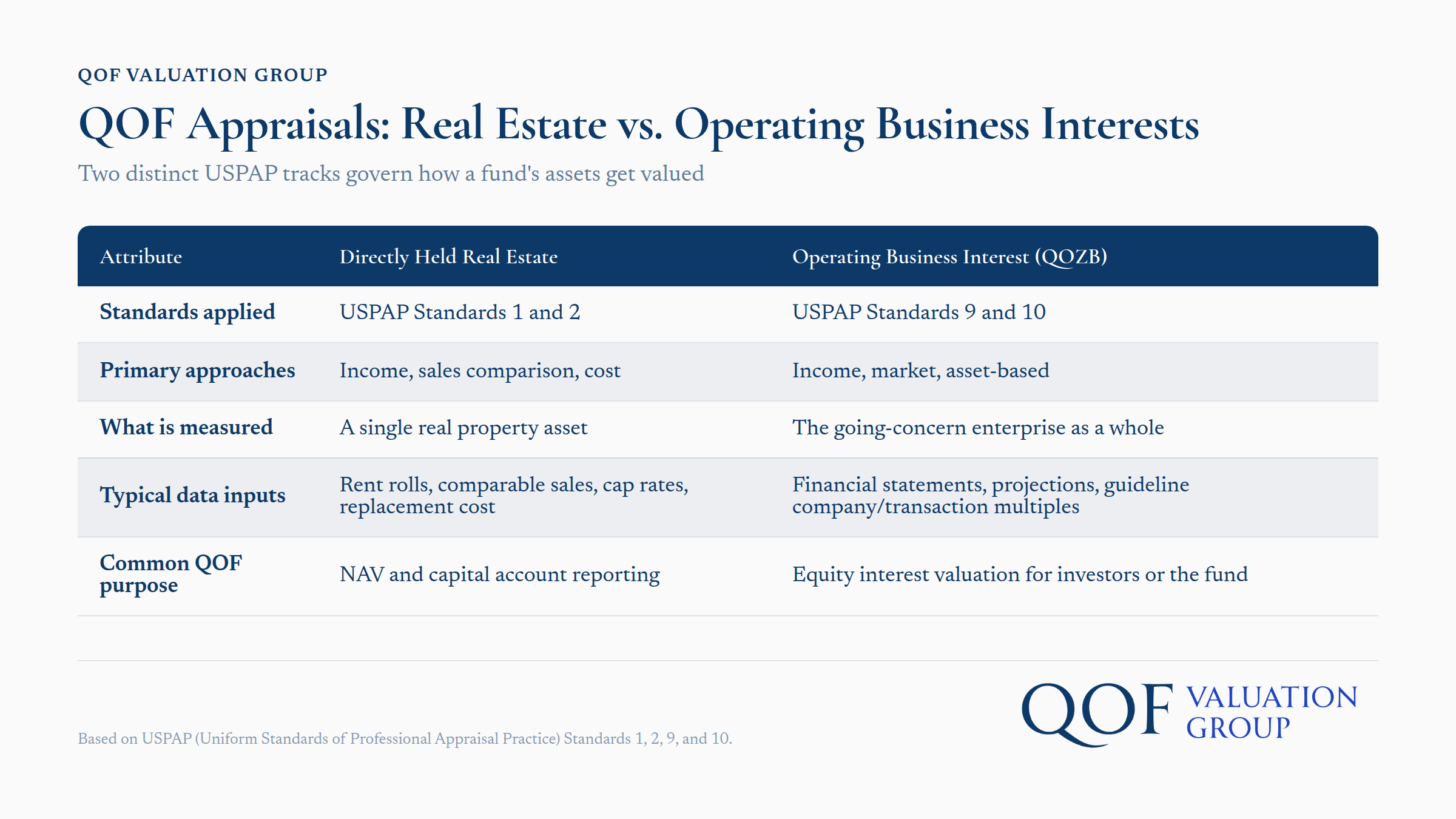
The table below lays out how the two tracks diverge inside a QOF context.
| Attribute | Directly Held Real Estate | Operating Business Interest (QOZB) |
|---|---|---|
| Standards applied | USPAP Standards 1 and 2 | USPAP Standards 9 and 10 |
| Primary approaches | Income, sales comparison, cost | Income, market, asset-based |
| What is measured | A single real property asset | The going-concern enterprise as a whole |
| Typical data inputs | Rent rolls, comparable sales, cap rates, replacement cost | Financial statements, projections, guideline company or transaction multiples |
| Common QOF purpose | NAV and capital account reporting | Equity interest valuation for investors or the fund |
How Directly Held Real Estate Is Appraised
Real property held directly by a QOF is typically appraised using three approaches to value, applied together and reconciled into a single conclusion. The income approach capitalizes or discounts the property's net operating income, using either direct capitalization or a discounted cash flow model. The sales comparison approach benchmarks the subject against recent sales of similar properties. The cost approach estimates what it would cost to replace the improvements, less depreciation, plus land value.
For most income-producing QOZ real estate, the income approach carries the most weight, since investors and lenders price real estate based on the cash flow it generates. Inside a QOF, this real property valuation typically supports net asset value (NAV) calculations and capital account reporting rather than a standalone sale.
How Operating Business Interests Are Valued: Enterprise Value, Not a Single Asset
An operating business interest is valued as an enterprise, not as a collection of assets. Enterprise value captures the worth of the entire operating business as a going concern: its tangible assets, its working capital, and its intangible assets (customer relationships, assembled workforce, brand, contracts) all together. That is a fundamentally different exercise than pricing a single building.
Three approaches typically apply:
- Income approach: a discounted cash flow analysis or a capitalization of normalized earnings, projecting what the business is expected to generate going forward.
- Market approach: guideline public company multiples or guideline transaction multiples drawn from sales of comparable businesses.
- Asset-based approach: most relevant for holding companies or early-stage QOZBs that have not stabilized cash flow, where the sum of underlying asset and liability values drives the conclusion more than earnings do.
A QOZB that operates a hotel, a manufacturing facility, or a multi-tenant commercial venture out of its QOZ real estate is valued this way, as the enterprise, with the real estate as one input among several rather than the subject of the appraisal itself.
The Original Use and Substantial Improvement Tests Shape What Qualifies
Before valuation even starts, a threshold question determines whether property counts as qualified opportunity zone business property at all. Under 26 CFR 1.1400Z2(d)-1-1), tangible business property generally has to be either original-use property in the zone or substantially improved. The substantial improvement test requires that additions to basis during any 30-month period exceed the property's adjusted basis at the start of that period.
Real property gets a more forgiving rule. Instead of the standard substantial-improvement threshold, real property can qualify through a special non-original-use provision: it satisfies the requirement if it is improved by more than an insubstantial amount, a materially lower bar than doubling the basis within 30 months. That flexibility is one reason so many QOF sponsors default to a real estate strategy over an operating business strategy when a property already exists in the zone.
The 90% Asset Test and the 10-Year Basis Step-Up
A QOF has to hold at least 90% of its assets in qualified opportunity zone property, tested on two dates each year, typically the last day of the fund's first six-month period and the last day of its tax year, according to the IRS's Opportunity Zones FAQ. For the test itself, a QOF with an applicable financial statement can generally value its assets, real estate and business interests alike, at GAAP book value; a fund without one falls back to unadjusted cost basis, as a practitioner analysis of the 90% test explains. Whether real estate or a QOZB interest is doing the heavier lifting toward that 90%, the valuation conclusion on each asset feeds directly into whether the fund passes.
The other side of the calendar matters just as much to investors. If they hold their QOF investment for at least 10 years, they can elect to step up the basis of that investment to its fair market value at the time of sale or exchange, excluding any appreciation that accrued after the original investment. That election turns the fund's exit valuation, whether it is a real property sale or a sale of the operating business, into a number with direct tax consequences for every investor on the cap table.
When a QOZB Owns Real Estate, the Two Disciplines Work Together
Plenty of QOZBs are not pure operating companies sitting on leased space. They own the real estate they operate from. In that case, the two valuation disciplines do not compete, they combine.
Practitioners typically have the real property appraised separately, using the same income, sales comparison, and cost approach methodology described above. That standalone real property conclusion then gets folded into the business valuation, either as a line item under the asset-based approach or embedded directly in the QOZB's projected cash flows if the property is central to how the business generates income (a hotel or a self-storage facility, for example). The result is a single business valuation report that is internally consistent with a real property appraisal, rather than two disconnected numbers that don't reconcile.
Watch out: A common mistake is having a general business appraiser estimate the real estate's value informally, or having a real estate appraiser attempt an enterprise valuation. Each discipline has its own standards, data sources, and reconciliation methods, and a report that blends them without separating the analysis tends to draw scrutiny.
Scope Your Fund's Appraisal Before the Testing Date Arrives
Whether your fund's 90% test hinges on a distribution warehouse or a controlling interest in the QOZB that runs it, the appraisal approach has to match the asset. Our team scopes QOF engagements around what the fund actually holds: real property appraisals under USPAP Standards 1 and 2, and business or equity interest valuations under Standards 9 and 10, coordinated so the two conclusions reconcile with each other. Every engagement is quoted as a fixed fee once we understand the fund's structure and holdings, never billed by the hour. Reach out and our appraisers can walk through what your fund's real estate and operating business interests will need before your next testing date.
This article is provided for general informational purposes only and does not constitute legal, tax, or financial advice. Readers should consult a qualified attorney or CPA regarding their specific circumstances.