
Blog
QOF 90% Asset Test Valuation Method: Financial Statement Method vs Alternative Method vs Appraisal
The qof 90% asset test valuation method is a choice between the applicable financial statement method and the cost-based alternative method, not between statements and an appraisal. This guide shows how each method values assets, where an appraisal actually belongs, and how to stay consistent for the year.
Published
A qualified opportunity fund must hold at least 90% of its assets in qualified opportunity zone property, and the value assigned to each asset drives that percentage. Many fund managers assume the choice is between audited financial statements and a full appraisal. It is not. The regulations give a QOF two valuation methods for the 90% investment standard, and an independent appraisal is not a third one. This guide explains both methods, where fair market value does enter the picture, and where our valuation team becomes relevant. If you are still working through the filing mechanics, our guide to IRS Form 8996 and QOF self-certification covers the form itself.
Key takeaway: For the 90% asset test, a QOF picks either the applicable financial statement method or the alternative valuation method for the taxable year. Appraisals only support the fair market value inputs that those rules call for.
How Does the QOF 90% Asset Test Work?
The 90% test compares the value of a QOF's qualified opportunity zone property to the value of all its assets. Under the Treasury regulation on QOF asset valuation-1), the fund measures this on two testing dates and averages the results. The Form 8996 instructions walk through the computation and reporting.
The two testing dates are:
- The last day of the first 6-month period of the taxable year
- The last day of the taxable year
The 90% figure is the average of the percentages on those two dates. A fund that falls short can owe a monthly penalty under IRC 1400Z-2(f), subject to the reasonable cause rules. Because the denominator and numerator both depend on how assets are valued, the valuation method matters as much as the assets themselves.
The Two Permitted Valuation Methods
A QOF uses one of two methods to value its assets for the asset test: the applicable financial statement (AFS) method or the alternative valuation method. The regulations do not list independent appraisal as a method. Everything else in this post follows from that structure.
Applicable Financial Statement Method
Under the AFS method, each asset is valued as reported on the QOF's applicable financial statement for the testing period. An applicable financial statement is a defined term under Treas. Reg. 1.475(a)-4(h), so an informal internal schedule or management report does not qualify.
Leased property carries an extra condition. The AFS method works for leased assets only if the statement is prepared under U.S. GAAP and assigns the leased asset a value.
Alternative Valuation Method
The alternative method is cost-based. Each asset's value depends on how the fund came to hold it:
- Purchased or constructed property: valued at unadjusted cost basis under the basis rules of IRC 1012 and 1013, with no depreciation adjustments
- Leased property: valued at the present value of the lease payments, determined when the lease is entered into
- Property not purchased or constructed for fair market value: valued at its fair market value
The last bullet is where valuation work enters. Everything else in the alternative method is arithmetic on records the fund already keeps.
AFS Method vs Alternative Method: Side-by-Side Comparison
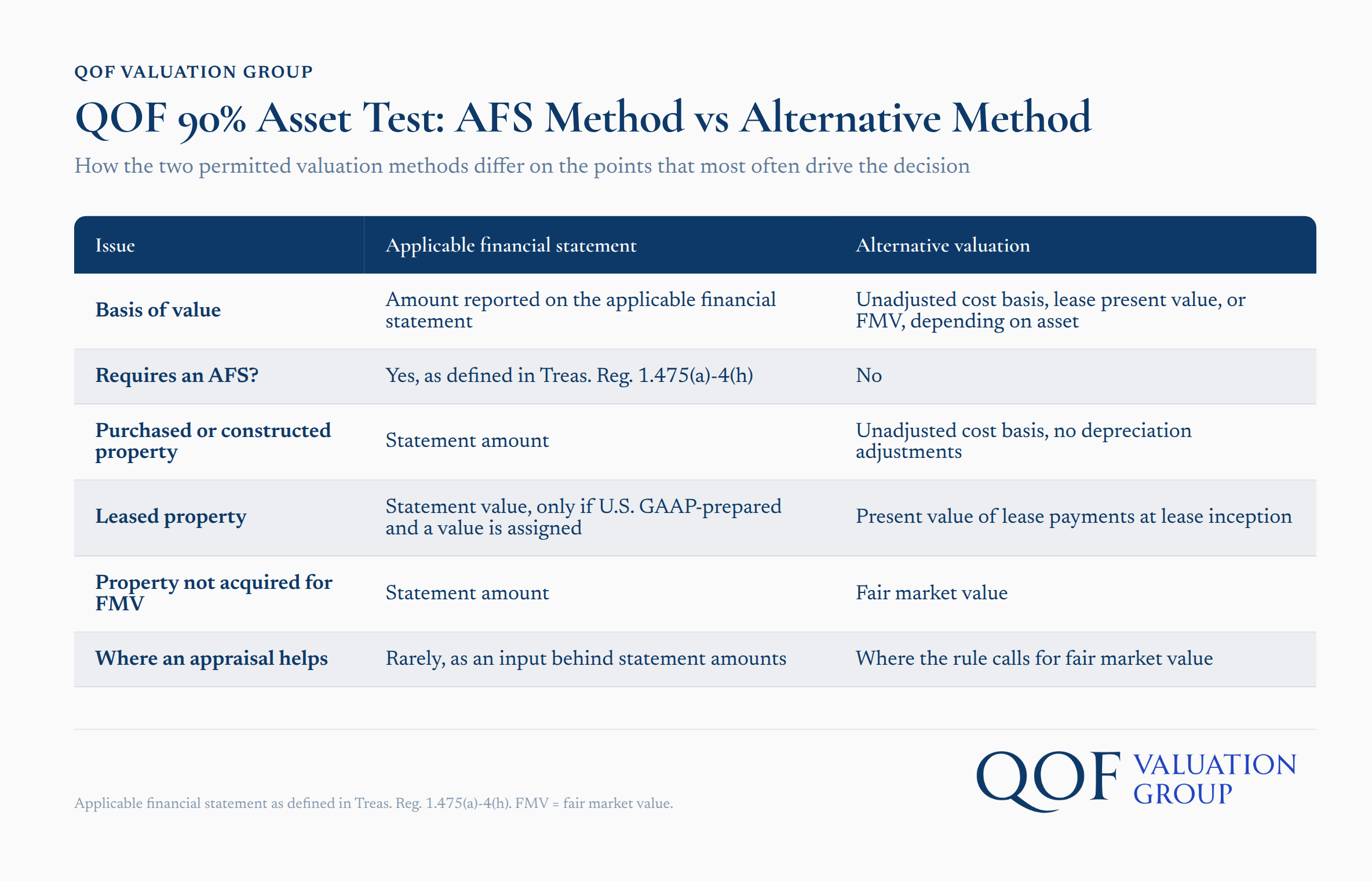
The table below compares the two permitted methods across the points that most often drive the decision.
| Issue | Applicable financial statement method | Alternative valuation method |
|---|---|---|
| Basis of value | Amount reported on the applicable financial statement | Unadjusted cost basis, lease present value, or fair market value, depending on the asset |
| Requires an AFS? | Yes, as defined in Treas. Reg. 1.475(a)-4(h) | No |
| Purchased or constructed property | Statement amount | Unadjusted cost basis, no depreciation adjustments |
| Leased property | Statement value, only if prepared under U.S. GAAP and a value is assigned | Present value of lease payments at lease inception |
| Property not acquired for fair market value | Statement amount | Fair market value |
| Where an appraisal helps | Rarely, as an input behind statement amounts | Where the rule calls for fair market value |
Does Having an AFS Make the Financial Statement Method Mandatory?
No. A fund with an applicable financial statement may still use the alternative method. The AFS method is available to funds that have a qualifying statement; it is not required of them.
The choice is made for the taxable year, and it must be applied consistently to the assets valued for that year. A fund cannot use statement values for one asset and cost basis for another to produce a better percentage. Pick the method before the first testing date and apply it on both.
Pro tip: Run both calculations in a draft model before the first testing date. If the percentages differ meaningfully, the difference often traces to depreciation, because the alternative method ignores it while financial statements typically reflect it.
Where an Appraisal Actually Belongs in the Asset Test
An independent appraisal is not an alternative to the two methods. It supports a fair market value input when the selected method's rules require one, most commonly for property the QOF did not purchase or construct.
Example: A fund receives a building from an investor as a contribution rather than buying it. Under the alternative method, that property is not purchased or constructed for fair market value, so the fund needs a defensible fair market value to include in the 90% calculation. A USPAP-compliant valuation gives the fund a documented figure to support that entry if the IRS asks.
For a fund that buys everything at arm's length and holds no contributed property, the alternative method may never call for an appraisal at all. That is why "audited statements vs full appraisal" is the wrong frame. The question is which method the fund selected, and whether any asset falls into a category that needs fair market value.
Watch out: Do not substitute a current appraisal for cost basis on purchased property under the alternative method. The rule says unadjusted cost basis, so appreciation does not enter the calculation.
Where Appraisals Do Matter in Other QOF Situations
Outside the 90% asset test, valuation carries real weight in several QOF contexts. Our team supports these as a valuation group, and business valuation work is performed remotely. Fund managers and their CPAs can request an appraisal once the scope is clear.
The situations where valuation work most often applies are:
- Non-cash contributions: When an investor contributes property instead of cash, the property's fair market value compared with the investor's basis affects how the contribution is treated, as the IRS describes on its page for investing in a qualified opportunity fund.
- Inclusion events: The amount of deferred gain included in income can depend on the fair market value of the fund interest, so the date-specific figure needs support.
- 10-year basis step-up: An investor who holds the interest for at least 10 years may elect a basis equal to fair market value on the date of sale or exchange, which makes the valuation the number that sets the tax result.
- Fund interest valuation: Minority and non-controlling interests are often valued with consideration of lack of control and lack of marketability. Our article on valuing a QOF minority interest explains how those adjustments are supported.
These are separate questions from the asset test, and they use different valuation standards. A report built for an inclusion event is not a substitute for the asset test valuation, and the reverse is also true. Our appraisers hold credentials with leading organizations such as the ASA and NACVA, and reports are prepared in accordance with USPAP, published by The Appraisal Foundation.
Documentation That Protects the Fund
Whichever method a QOF selects, documentation should show the method, the dates, and the source of every value. Auditors and reviewers look for consistency more than for any particular number.
A sound file for the asset test generally includes:
- A written record of the method elected for the taxable year
- Testing-date schedules for both the mid-year and year-end dates
- Closing statements or invoices that support cost basis on purchased assets
- Lease agreements and the calculation of present value at inception
- Fair market value support for any property not purchased or constructed for fair market value
- The AFS and its qualification basis, where the AFS method is used
Good file-building also means cross referencing each schedule to its backup so a reviewer can trace any value to its source quickly. That habit saves time when a lender, auditor, or IRS examiner asks how a figure was derived.
Choosing Your Method With Confidence
The qof 90% asset test valuation method comes down to a single decision: the applicable financial statement method or the alternative valuation method, applied consistently for the year and tested on both semiannual dates. An appraisal enters only where the rules call for fair market value, and it plays a much larger role in contributions, inclusion events, step-ups, and fund interest valuations. If your fund holds contributed property or faces an inclusion event, we can scope the valuation work and quote a fixed fee before work begins. Our engagements are never billed hourly.
This article is provided for general informational purposes only and does not constitute legal, tax, or financial advice. Readers should consult a qualified attorney or CPA regarding their specific circumstances.