
Blog
IRS Form 8997: What Qualified Opportunity Fund Investors Must Report Every Year
IRS Form 8997 is the annual statement every Qualified Opportunity Fund investor must file to report deferred gains, dispositions, and year-end holdings. This guide breaks down all four parts of the form and explains why an independent valuation protects the basis and gain figures behind it.
If you invested capital gains into a Qualified Opportunity Fund (QOF), the IRS does not let you forget about it once tax season passes. Every year you hold that investment, you owe the IRS an update. That update is IRS Form 8997, and getting it right depends on numbers, basis and fair market value, that are much harder to pin down than most investors expect.
What Is IRS Form 8997?
Form 8997, titled "Initial and Annual Statement of Qualified Opportunity Fund (QOF) Investments," is the form the IRS uses to track every QOF interest you hold, the capital gains you deferred by investing in it, and what happened to that investment during the year. The IRS's official instructions describe it as the mechanism for reporting deferred gains held at the beginning and end of the tax year, plus any gains deferred or investments disposed of in between.
In plain terms: if you have money parked in a Qualified Opportunity Fund, the IRS wants a fresh accounting of it every single year, not just the year you made the investment.
Who Must File Form 8997, and When?
Any taxpayer who held a QOF investment at any point during the tax year must file Form 8997, even if nothing changed that year. The IRS states plainly that an eligible taxpayer holding a QOF investment at any point during the tax year must file Form 8997 with the taxpayer's timely filed federal income tax return, including extensions.
That requirement is broad by design. It applies to:
- Individual investors reporting on Form 1040
- Partnerships, S corporations, and trusts with QOF interests
- Estates holding QOF investments as part of estate administration
- Investors who made no new contributions and had no dispositions that year (a quiet holding year still requires the filing)
Watch out: Form 8997 is not a standalone filing. It attaches to whatever return you're already filing, so missing it usually means an incomplete return, not a separate delinquency. CPAs preparing returns for QOF investors should treat it as a standard checklist item every year the investment is open, not just at entry and exit.
The Four Parts of Form 8997
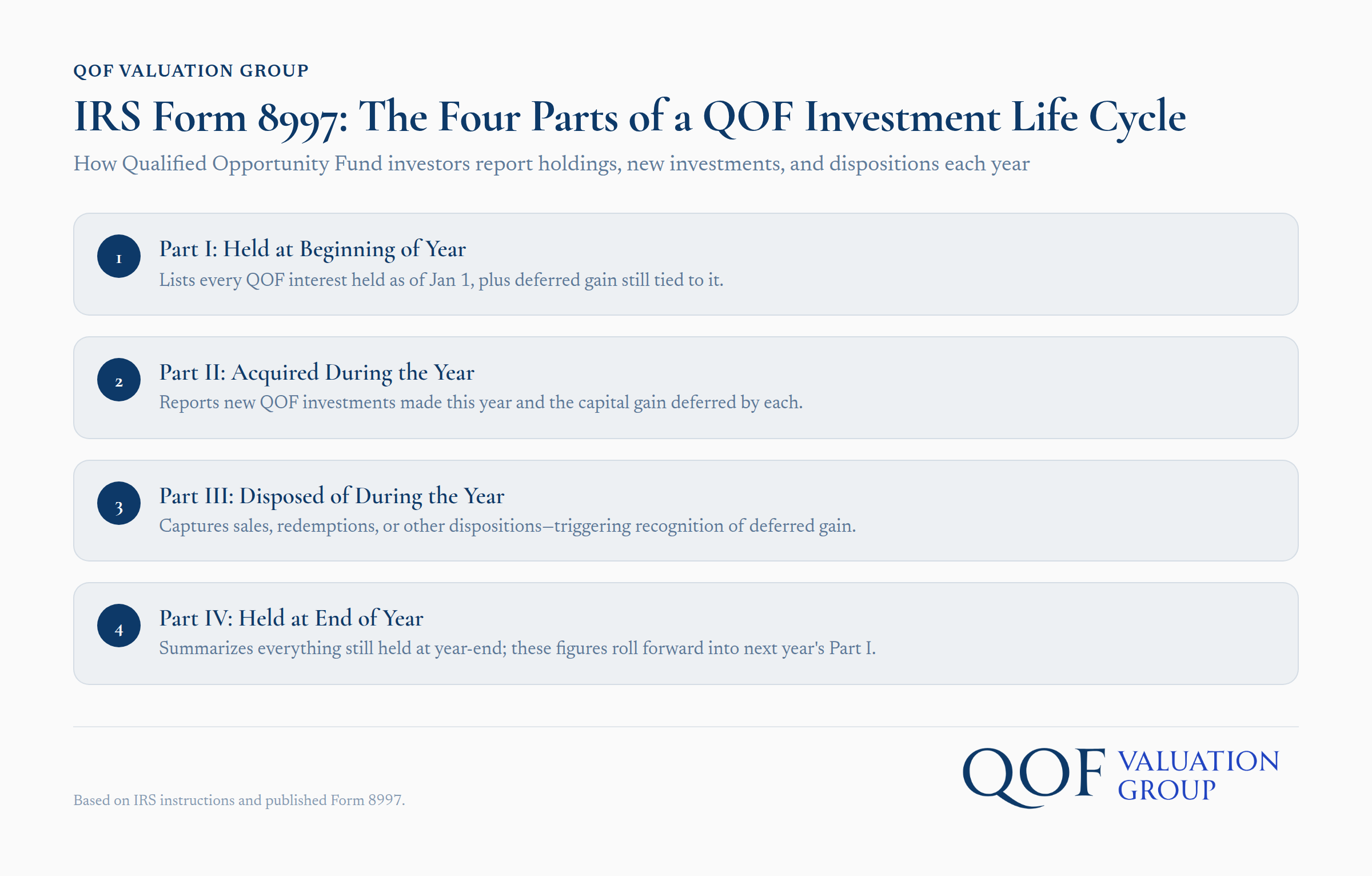
Form 8997 is built around the life cycle of a QOF investment, from the day you acquire it to the day you exit. According to the IRS instructions and published form, the form is split into four parts:
- Part I: QOF Investments Held at the Beginning of the Tax Year
- Lists every QOF interest you held as of the first day of the year, along with the deferred gain still tied to it.
- Part II: QOF Investments Acquired During the Tax Year
- Reports any new QOF investment made during the year and the amount of capital gain deferred by that investment.
- Part III: QOF Investments Disposed of During the Tax Year
- Captures sales, redemptions, or other dispositions, which is how the IRS identifies inclusion events that trigger recognition of previously deferred gain.
- Part IV: QOF Investments Held at the End of the Tax Year
- Summarizes everything still held at year-end. These figures roll forward and become next year's Part I.
Pro tip: Keep a running worksheet outside your tax software that mirrors these four parts. Since Part IV of one year becomes Part I of the next, a reconciliation error compounds every year it goes uncorrected.
One Line Per Investment: What Details Are Required
Each QOF investment gets its own line on Form 8997. You cannot aggregate multiple investments, even if they're in the same fund family or made in the same year. For every line, the form requires:
- The QOF's Employer Identification Number (EIN): this identifies the specific fund and must match the fund's own filings and your account statements.
- The date you acquired the interest: this establishes your holding period, which drives eligibility for the basis adjustments discussed below.
- A description of the investment: for example, a number of shares in a corporate QOF or a percentage interest in a partnership QOF.
- The short-term deferred or included gain amount: the portion of deferred gain classified as short-term, or the amount recognized as short-term if the interest was disposed of.
- The long-term deferred or included gain amount: the same breakdown for long-term gain.
This line-by-line requirement is why investors with multiple QOF positions, especially those who added to a fund across several years, often underestimate how much recordkeeping the annual filing actually demands.
How Basis Works for a QOF Investment
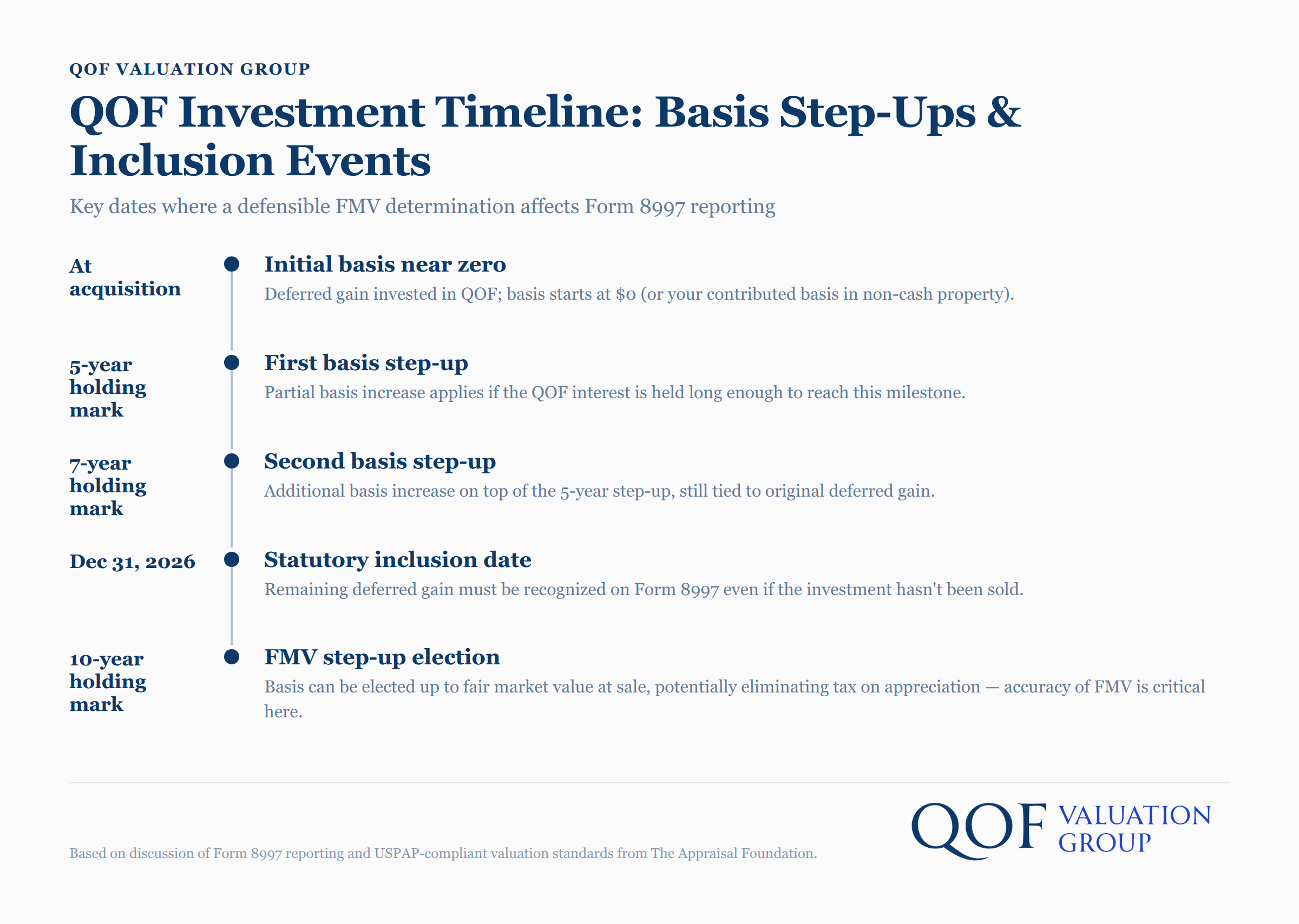
Basis in a QOF investment starts low and moves in predictable steps tied to how long you hold it. For most investors who rolled a capital gain into a QOF, initial basis in the investment is generally zero, since the money you contributed represented untaxed, deferred gain rather than after-tax capital.
A separate rule applies when you contribute property instead of cash: if you roll appreciated non-cash property into a QOF, the amount eligible for deferral is capped at your basis in that property, not its fair market value. Any built-in gain above your basis does not qualify for deferral treatment, which makes an accurate basis determination on the contributed asset essential from day one.
From there, the original version of the Opportunity Zone program built in basis step-ups tied to the holding period, generally increasing basis at the 5-year and 7-year marks for investments made early enough in the program's life to reach those milestones before the 2026 deadline. The most consequential adjustment, however, comes at the 10-year mark: an investor who holds a QOF interest for at least 10 years can elect to step up basis to the property's fair market value at the time of sale or exchange, which can eliminate tax on appreciation earned inside the fund.
The December 31, 2026 Inclusion Date
Deferred gain does not stay deferred forever. Under the IRS's Opportunity Zone guidance, eligible gain invested in a QOF can be deferred until an inclusion event occurs or until December 31, 2026, whichever happens first. For most long-term holders, that date is now the operative deadline, since it arrives before many investors would otherwise trigger a sale.
When deferral ends, whether through an inclusion event or the 2026 deadline, the IRS uses a specific formula to calculate the Reportable Deferred Gain:
- Compare the original deferred gain to the fair market value of the QOF investment at that time, and take whichever figure is lower.
- Subtract your basis in the QOF investment from that lesser figure.
- The result is the Reportable Deferred Gain, which flows into your income and onto Form 8949 and Schedule D, and is tracked annually on Form 8997.
Example: Say you deferred a $200,000 gain into a QOF in 2020. By the 2026 inclusion date, your basis has stepped up to $30,000 and the interest's fair market value is $180,000. Because FMV ($180,000) is lower than the original deferred gain ($200,000), you use $180,000, then subtract your $30,000 basis. Your Reportable Deferred Gain is $150,000.
Notice how much that number depends on one input the IRS does not calculate for you: fair market value.
Why an Independent Valuation Matters for the Numbers on Form 8997
Fair market value is not a formality on Form 8997. It is a direct input into how much deferred gain gets recognized, and it drives whether a 10-year holder's basis step-up election actually erases the tax on appreciation. When a QOF interest trades on no public market, which describes most Opportunity Zone partnerships and closely held fund vehicles, that FMV has to come from somewhere defensible.
This is where an independent valuation earns its keep. A handful of moments in the life of a QOF investment hinge on a credible FMV determination:
- Contributing non-cash property: since deferral is capped at your basis, not FMV, you need a clear, documented basis figure to know exactly how much gain qualifies for deferral in the first place.
- An inclusion event or disposition: the lesser-of-FMV-or-deferred-gain formula only works if the FMV figure holds up under scrutiny.
- The 10-year exclusion election: stepping basis up to FMV at sale is only as good as the FMV supporting it. An unsupported number invites the IRS to substitute its own.
A business valuation prepared in accordance with USPAP, the standards published by The Appraisal Foundation, gives investors and their CPAs a documented, methodology-driven number rather than a guess. Our valuation team at QOF Valuation Group includes analysts holding credentials with organizations including the American Society of Appraisers (ASA) and the National Association of Certified Valuators and Analysts (NACVA), alongside professionals credentialed through the CFA Institute and the AICPA's Accredited in Business Valuation (ABV) designation. No valuation, however well prepared, guarantees a specific outcome with the IRS. What a defensible, standards-compliant report does is give your Form 8997, Form 8949, and Schedule D entries a consistent, well-supported basis, which is exactly what a reviewer looks for when a large deferred gain comes up for examination.
Key takeaway: the IRS will accept whatever numbers you file, but it is the taxpayer's job to be able to defend them. An independent, USPAP-compliant valuation is how QOF investors build that defense before it's ever needed.
How Form 8997 Connects to Form 8949 and Schedule D
Form 8997 does not stand alone. According to Wolters Kluwer's summary of the IRS forms, the deferred gain amounts reported on Form 8997 need to reconcile with the corresponding entries on Form 8949 and Schedule D. When you first defer a gain into a QOF, that transaction shows up on Form 8949 with specific codes marking it as a QOF deferral. When an inclusion event or disposition occurs, the recognized gain flows through the same forms.
In practice, this means Form 8997's Part II deferred-gain totals for the year should match the corresponding entries on Form 8949, and Part III dispositions should tie directly to whatever gain is recognized on Schedule D. A CPA reconciling these forms at filing time is really checking that the story told across all three documents, the fund summary, the transaction detail, and the capital gains schedule, adds up to the same numbers.
Frequently Asked Questions
Q: Do I need to file Form 8997 if I didn't buy or sell any QOF interest this year? Yes. If you held a QOF investment at any point during the tax year, even with no new contributions or dispositions, the IRS requires an annual Form 8997 filing attached to your timely filed return.
Q: What happens if I hold multiple QOF investments in different funds? Each investment gets reported on its own line, with its own EIN, acquisition date, and gain figures. You cannot combine multiple QOF interests into a single line, even if you view them as one overall Opportunity Zone strategy.
Q: Does the fair market value I report need to come from an appraiser? The IRS does not name a mandatory appraiser requirement for every FMV figure, but at inclusion events, dispositions, and the 10-year exclusion election, FMV directly determines your taxable gain. Given that exposure, most investors and their CPAs rely on an independent valuation to support the number rather than relying on an internal estimate.
Q: What happens to my deferred gain if I still hold my QOF interest after December 31, 2026? The deferral itself ends on that date regardless of whether you've sold. You'll recognize the Reportable Deferred Gain using the lesser-of-FMV-or-deferred-gain formula, subtract your basis, and report the result, so an FMV determination becomes necessary even without a sale.
Protect the Numbers Behind Your Form 8997 Filing
Form 8997 asks for precise figures every single year: EINs, acquisition dates, deferred gain, and basis. Behind several of those figures sits a fair market value determination that the IRS will lean on heavily if your filing is ever reviewed, particularly around an inclusion event or a 10-year exclusion election. Our team at QOF Valuation Group prepares independent, USPAP-compliant valuations for Opportunity Zone investors and the CPAs who file on their behalf, giving the basis and gain calculations behind your Form 8997 the documentation they need to hold up. If you're approaching an inclusion event, a disposition, or the 10-year mark on a QOF investment, request an appraisal before you file.
This article is provided for general informational purposes only and does not constitute legal, tax, or financial advice. Readers should consult a qualified attorney or CPA regarding their specific circumstances.