
Blog
The 180-Day QOF Investment Deadline Explained: When Does Your Clock Start?
The 180-day QOF investment deadline determines exactly how long you have to move a capital gain into a Qualified Opportunity Fund, but the clock doesn't always start on your sale date. This guide breaks down the different start-date rules for direct sales, Section 1231 gains, pass-through entities, and installment sales, so you know precisely which deadline applies to your gain.
The 180-day QOF investment deadline is the single most consequential date in Opportunity Zone tax planning. Miss it, and the capital gain you were counting on to defer is gone for good: recognized and taxed in the year it arose, with no second chance. This guide walks through exactly when that 180-day clock starts for a direct sale, a Section 1231 gain, a pass-through entity allocation, and an installment sale, plus what happens if the window closes before you invest.
If you're new to how these vehicles work, our guide on what a Qualified Opportunity Fund is and how it operates covers the basics before you dig into the timing rules below.
When Does the Clock Start for a Direct Capital Gain Sale?
For most investors selling stock, real estate, or other property directly (not through a partnership, S corporation, estate, or trust), the 180-day period begins on the date of the sale or exchange that produces the gain. That is the default rule under the statute, and it's the one the IRS's Opportunity Zones FAQ states plainly: the first day of the 180-day period is the date the gain would be recognized for federal income tax purposes if you hadn't elected to defer it.
The underlying rule comes straight from Internal Revenue Code Section 1400Z-2(a), which limits the deferral to the amount invested in a Qualified Opportunity Fund "during the 180-day period beginning on the date of such sale or exchange." A few mechanical details matter here:
- The count is calendar days, not business days. Day 1 is the sale date itself, and the window runs for 180 consecutive days from there.
- There's no automatic extension for weekends or holidays. If day 180 lands on a Sunday, the deadline is still that Sunday.
- The clock tracks when money actually funds the QOF, not when subscription paperwork gets signed. Cash needs to arrive at the fund by day 180.
For a securities sale reported on a 1099-B or a direct sale of real property held individually, this is the only 180-day period available. There's no alternative start date to elect.
The Special Rule for Section 1231 Gains
Section 1231 gains, the kind that come from selling business-use property such as equipment, machinery, or business real estate, don't follow the same clock as a straightforward capital asset sale. Because Section 1231 gains and losses are netted across the entire tax year before they're characterized as capital gains, the 180-day period for a calendar-year taxpayer generally begins on December 31 of the year the net gain arises, rather than on the date of the individual sale that generated it.
Example: A business sells a piece of equipment in March and realizes a Section 1231 gain for the year once all its 1231 transactions are netted at year-end. The 180-day clock doesn't start in March. It starts on December 31, which pushes the deadline to invest into a QOF into roughly the following June.
This timing quirk trips up a lot of business owners who assume the clock starts the moment they sign a bill of sale. If your gain flows from the disposition of depreciable business property, confirm whether it's a Section 1231 gain before you calculate your deadline.
Pass-Through Entities Get Three Start-Date Options
Partners in a partnership, shareholders in an S corporation, and beneficiaries of an estate or non-grantor trust don't have to use the entity's own sale date as their only option. Under the Treasury regulations, they can elect one of three separate 180-day periods:
- The entity's own sale date. The partner or shareholder's clock starts the same day the entity sold the underlying asset, mirroring the entity's own deadline.
- The last day of the entity's tax year. For a calendar-year partnership or S corporation, that's December 31.
- The due date of the entity's tax return, without extensions. That's generally March 15 of the following year for partnerships and S corporations, and April 15 for estates and non-grantor trusts.
A widely cited illustration in Opportunity Zone practitioner materials, drawn from an Opportunity Zones industry handbook, frames it this way: if a partnership sells appreciated property mid-year, an individual partner isn't locked into that sale date. They can instead choose to start their own 180-day period on December 31 of that year, or on the entity's unextended filing deadline the following spring, whichever gives them the runway they need.
Watch out: You get to pick one of the three windows, but you can't combine them or shift to a later option simply because you missed an earlier one. The election is effectively made by which window you actually invest within, so it pays to plan around the latest available start date if you're unsure when you'll have funds ready.
How Installment Sale Timing Works
Where a sale is reported under the installment method, the timing rules give the taxpayer some flexibility that a lump-sum sale doesn't have. Gain recognized as each installment payment is received can trigger its own 180-day period tied to the receipt of that specific payment, letting an investor defer each piece of gain as it's actually realized rather than racing to invest an entire multi-year sale price at once. This tracks the general principle that the 180-day clock is pegged to when a gain is recognized for federal income tax purposes, and for installment sales that recognition happens payment by payment rather than all at closing.
Investors selling business or investment property on an installment note should map out each payment date and its own 180-day window in advance, rather than assuming a single deadline covers the whole transaction.
Comparing the Start-Date Triggers
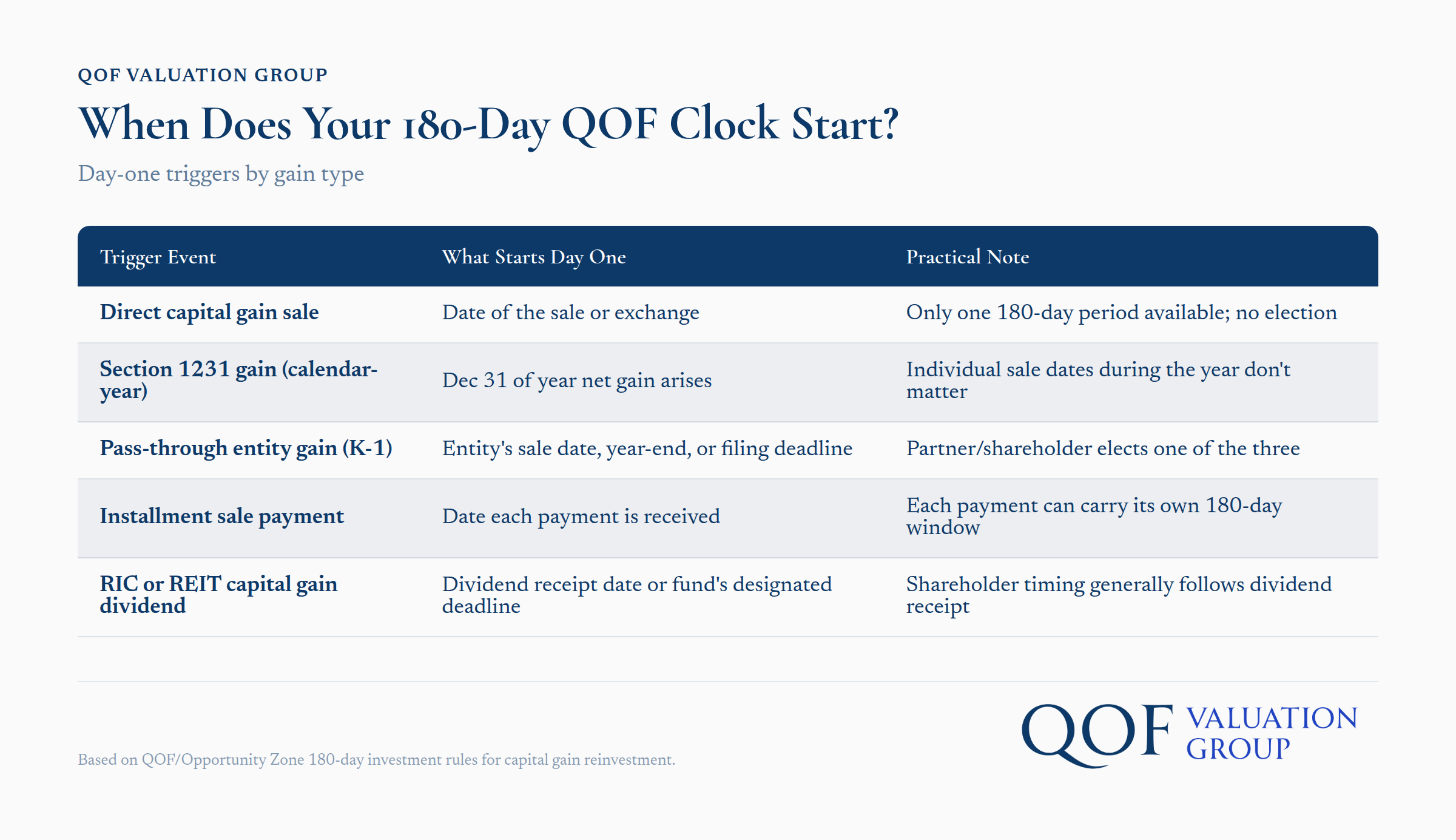
Each type of gain has its own answer to "when is day one." Seeing them side by side makes it easier to spot which rule applies to your situation.
| Trigger Event | What Starts Day One | Practical Note |
|---|---|---|
| Direct capital gain sale | Date of the sale or exchange | Only one 180-day period available; no election |
| Section 1231 gain (calendar-year taxpayer) | December 31 of the year the net gain arises | Individual sale dates during the year don't matter |
| Pass-through entity gain (K-1) | Entity's sale date, entity's year-end, or entity's unextended filing deadline | Partner or shareholder elects one of the three |
| Installment sale payment | Date each payment is received | Each payment can carry its own 180-day window |
| RIC or REIT capital gain dividend | Date the dividend is received, or the fund's designated deadline | Shareholder-level timing generally follows dividend receipt |
Why the December 31, 2026 Cutoff Doesn't Always Mean a 2026 Deadline
The Opportunity Zone statute requires that a gain be recognized on or before December 31, 2026 to qualify for deferral at all. That date is a hard eligibility cutoff, not the investment deadline itself. Once a gain is recognized within that window, the 180-day clock still applies on top of it, and depending on which start date applies, that clock can run well into 2027.
As industry analysis on extending the Opportunity Zone investment window points out, a pass-through gain electing the entity's unextended filing deadline as its start date, say March 15, 2027, would carry a final QOF investment deadline around September 11, 2027, roughly nine months after the statutory recognition cutoff. Don't confuse the last day a gain can be recognized with the last day you can actually invest it.
What Happens If You Miss the 180-Day Window?
Missing the deadline is unforgiving for the gain in question, but it's also narrowly contained. Here's what actually happens:
- The specific gain permanently loses QOF deferral eligibility. There's no retroactive fix once day 180 passes without a qualifying investment.
- That gain is recognized and taxed in its original year, as if the deferral election had never been considered.
- Other eligible gains you hold are unaffected. A missed deadline on one sale doesn't disqualify separate gains from separate transactions; each gain runs on its own 180-day clock.
- Future QOF investments remain available for future gains. A missed window doesn't bar you from investing new eligible gains in a QOF later, as long as those gains have their own 180-day period still open.
The one notable exception in recent history came through COVID-19 relief. As reporting on the IRS's pandemic-era deadline extensions confirms, the IRS temporarily pushed deadlines that would otherwise have fallen between April 1, 2020 and March 31, 2021 out to March 31, 2021. That relief was tied to a specific emergency and has since expired; absent new IRS action, the statutory 180-day rule governs without exception.
Once you've made a qualifying investment, tracking and reporting the deferred gain correctly matters just as much as hitting the deadline. Our guide to Form 8997 reporting requirements for QOF investors walks through what has to be filed each year the deferral remains outstanding.
Know Your Deadline Before You Sign Anything
The 180-day QOF investment deadline sounds like a single number, but it's really a family of rules that depends on how your gain arose. A direct sale, a Section 1231 gain, a K-1 allocation, and an installment payment can each carry a different day one, and choosing the wrong one can cost you the deferral entirely.
If you're contributing property or an interest into a Qualified Opportunity Fund and need a defensible valuation to support your basis, gain calculation, or year-end reporting, our team can help. Request an appraisal to get your QOF investment properly documented before your deadline arrives.
This article is provided for general informational purposes only and does not constitute legal, tax, or financial advice. Readers should consult a qualified attorney or CPA regarding their specific circumstances.